
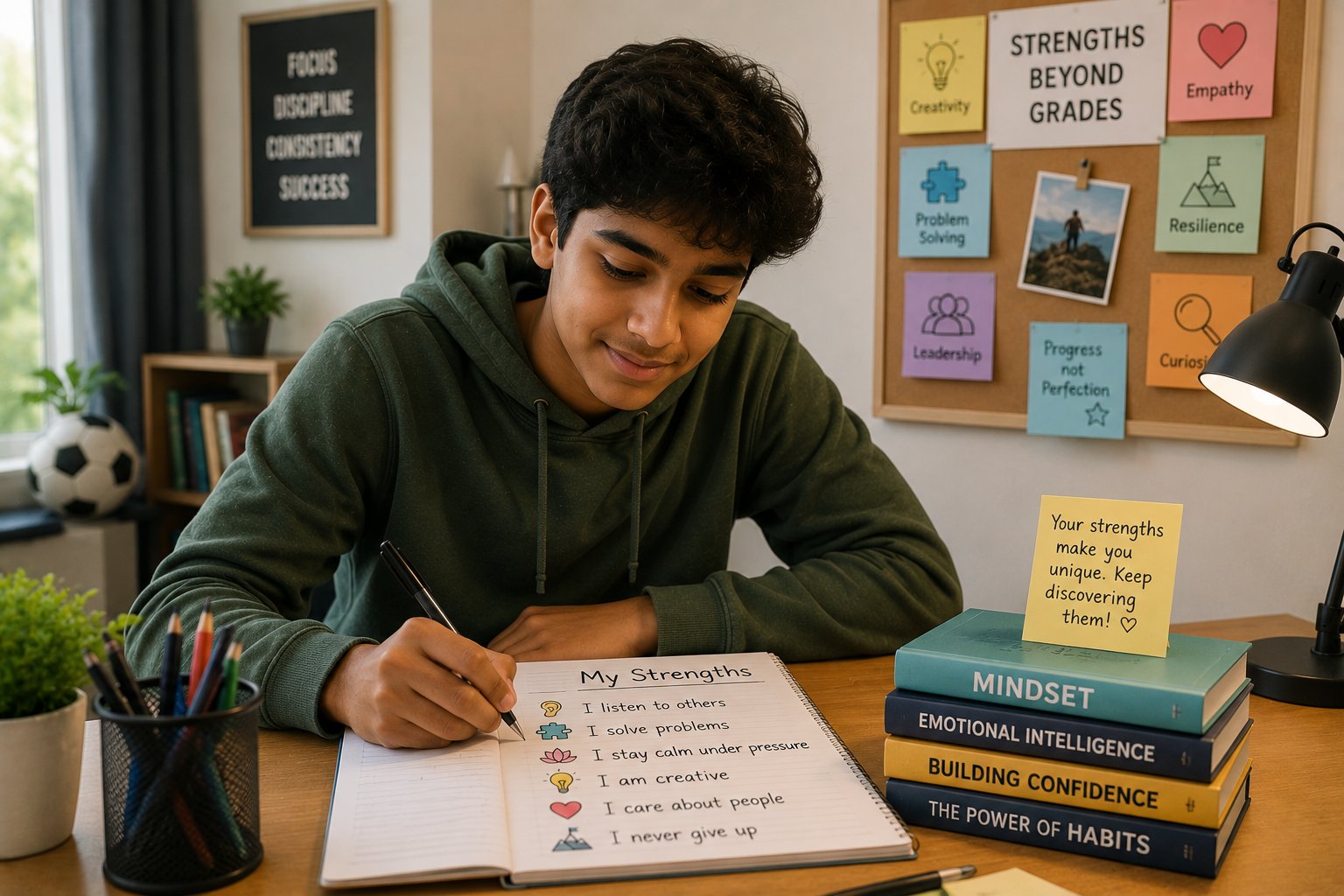
Every child in a mainstream school gets measured constantly: spelling tests, maths quizzes, reading levels, science marks, report cards every term. Ask the same school to describe a child's specific emotional strengths — not "well-behaved" or "a good student," but something genuinely specific like courage, fairness, or perseverance — and most schools have nothing structured to offer at all. The assessment infrastructure runs entirely one direction: academic strengths get measured relentlessly; character and emotional strengths get measured almost never.
The Research Behind Character Strengths as a Real, Measurable Thing
Psychologists Christopher Peterson and Martin Seligman spent years building something deliberately different from most psychological assessment, which had historically focused on diagnosing what's wrong. Their VIA Classification of Character Strengths and Virtues, published in 2004, identified 24 measurable character strengths — from curiosity and creativity to kindness, fairness, perseverance, and gratitude — organized under six broader virtues. Since publication, over 600 studies have used this framework, more than 50 of them specifically with schools, children, and adolescents.
Here's the finding that should genuinely change how schools think about assessment: research has found that children's use of their character strengths is associated with better wellbeing, better psychosocial functioning, and stronger academic achievement — over and above IQ scores. That last part matters enormously. This isn't a soft, feel-good adjunct to academic measurement. It's an independent predictor of real outcomes, sitting almost entirely outside what a report card currently captures.
Why "Signature Strengths" Matter More Than a General Score
A specific concept within this research is worth understanding directly: signature strengths — the small handful of character strengths, out of the full 24, that feel most authentically core to a specific person, the ones that show up as "the real me" rather than a strength they can access but don't feel defined by. Seligman's own criteria for identifying a signature strength include a genuine sense of ownership and authenticity when using it, and a feeling of energy rather than effort when doing so.
A well-known 2005 study by Seligman and colleagues, involving roughly 500 participants, tested a simple intervention: using one of your signature strengths in a new way each day for a week. Participants who completed this reported increased happiness and decreased depressive symptoms that persisted up to six months later — a remarkably durable effect from a genuinely simple exercise, and one built entirely around identifying strengths, not diagnosing deficits.
Why Schools Almost Never Do This
The honest answer is partly practical: research reviewing character strengths assessment in children has specifically flagged that most available tools are too long and burdensome for regular use in busy school settings. It's not that schools don't value character — it's that there's rarely a workable, efficient way to actually measure it at the scale a classroom demands, especially compared to a maths test that grades itself.
There's also a deeper cultural pattern at play: most educational assessment, by long-standing convention, is built to find deficits — what a child is getting wrong, what needs remediation — rather than built to map what a child is already strong in. A strengths-based assessment requires a genuinely different design philosophy, not just a different set of questions.
What a Genuine Strengths Assessment Actually Reveals
A well-designed assessment doesn't just tell a parent "your child is kind" in the abstract — it should reveal a genuine profile, showing which specific strengths are most authentically central to that particular child, distinct from strengths they can use competently but that don't define them. This is exactly the design principle behind Happy Sprout's own Spark Constellation tool — a strengths assessment built around 23 original "sparks" across five categories, designed specifically to map a child's authentic strengths profile rather than issue a single generic score.
The value of a genuine profile, rather than a single label, is that it gives parents something specific to actually work with: a child whose signature strength maps to perseverance benefits from different encouragement and different opportunities than a child whose signature strength maps to social intelligence or creativity — even if, on the surface, both children look like generally "good kids."
How to Use Strengths-Awareness at Home, With or Without a Formal Tool
Notice and name specific strengths, not general praise. "You were really fair when you split that up evenly" identifies a specific character strength; "good job" identifies nothing a child can build on.
Ask your child to try a known strength in a new context. Following the logic of Seligman's own research, if your child's strength is creativity, encourage them to apply it somewhere unexpected — organizing a family activity, not just art class — and notice the effect on their engagement and mood.
Watch for energy, not just competence, when identifying a true signature strength. A child might be capable at several things, but the signature strength is the one that seems to genuinely energize rather than merely occupy them — that distinction is worth deliberately observing over time.
Resist letting strengths-talk collapse into achievement-talk. A character strength like kindness or curiosity is valuable in itself, independent of whether it leads to a trophy or a grade — keeping the framing separate from outcomes is part of what makes strengths-based language protective rather than just another performance metric.
What to Do This Week
- Spend one week actively noticing and naming a specific strength your child displays, rather than general praise — write it down if it helps you notice the pattern.
- Ask your child to use a strength you've noticed in a new context this week, and observe whether it changes their engagement with the task.
- Consider a structured strengths assessment, rather than relying purely on impression, to get an actual profile rather than a parent's best guess.
Every child has a specific, genuine strengths profile sitting almost entirely unmeasured by the school system they spend most of their waking hours in. The report card was never going to find it — that was never what it was built to do.
Happy Sprout Action: Register your child for a live Happy Sprout SEL class at happysproutminds.com to start building on their unique strengths profile, guided by a trained facilitator.
Future Starts Within.