
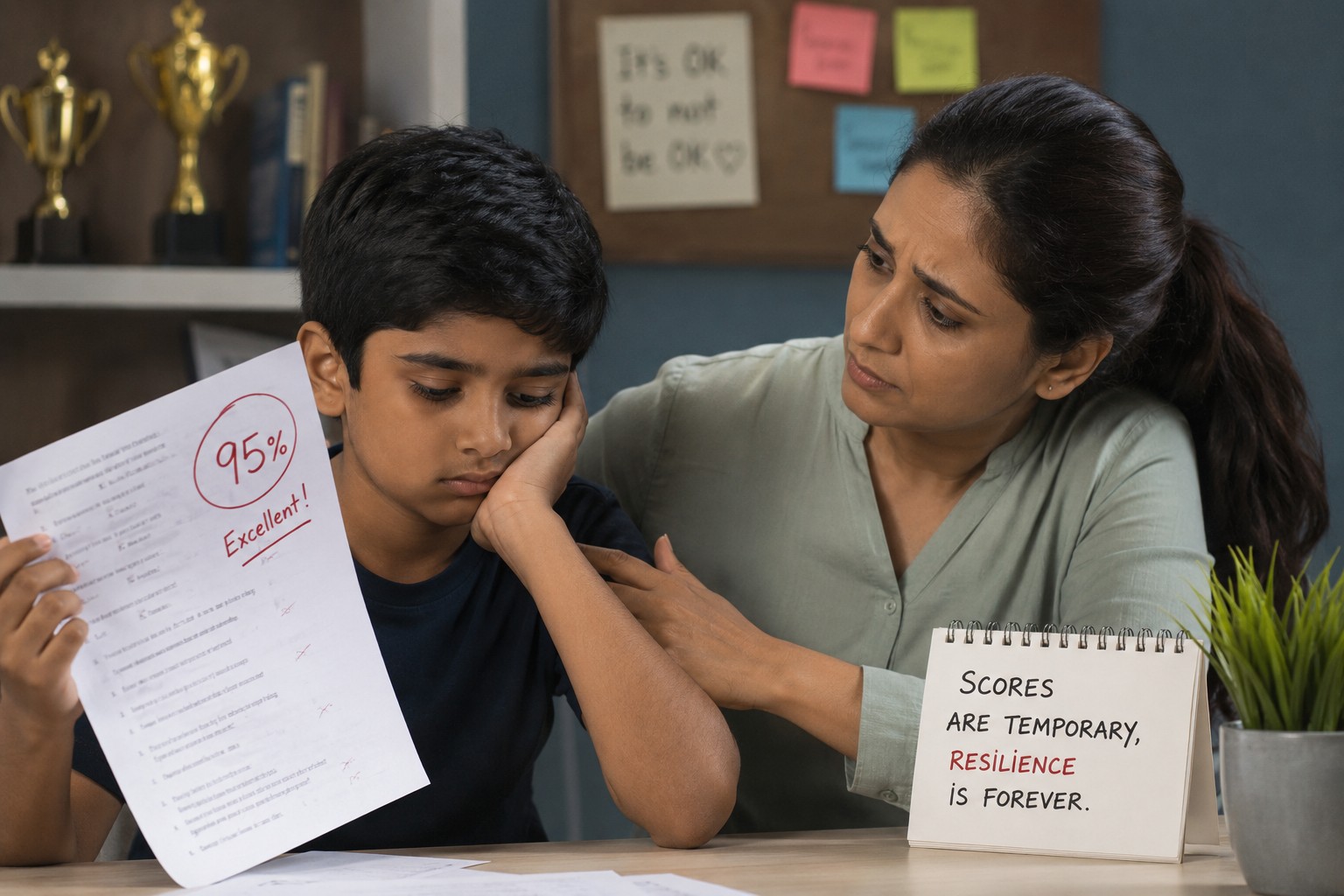
Here's a question worth sitting with honestly: if your child scored 95% on their last exam, do you actually know how they'd handle scoring 60% on the next one? Most parents assume the answer follows naturally from the first number — a child who performs that well academically must, surely, have the resilience to handle an occasional setback. Decades of research from psychologist Suniya Luthar suggests that assumption is not just wrong, but backwards.
The Research That Overturned the Assumption
Luthar's work, spanning more than two decades and covering thousands of students across high-achieving school communities, found something genuinely counterintuitive: students in high-achieving schools show rates of anxiety, depression, and substance abuse two to three times the national average — high enough that excessive achievement pressure is now formally listed among the top four highest-risk factors for adolescent mental health, in the same category as poverty, trauma, and discrimination.
Let that sit for a moment: academic excellence, far from protecting against emotional struggle, has been identified as a genuine risk factor in its own right when it comes bundled with the pressure that often produces it. The students scoring highest on the metric parents watch most closely are, as a population, statistically more vulnerable on the metrics almost nobody is tracking at all.
Why High Achievement and Emotional Resilience Aren't the Same Skill
Here's the mechanism Luthar's research points to directly: when a child's sense of self-worth becomes contingent on achievement, every academic setback stops being a specific, contained event and starts feeling like a referendum on their entire value as a person. A 60% doesn't just mean "I didn't understand this topic as well as usual" — for a child whose identity has fused with performance, it can mean "I am no longer who I thought I was."
This is precisely why a 95% score tells you almost nothing about emotional readiness. Academic performance measures content mastery. Emotional resilience measures how a person's sense of self survives contact with an outcome that doesn't go their way. These are genuinely different skills, developed through genuinely different experiences — and a child can be excellent at one while having had almost no practice with the other, particularly if their environment has quietly protected them from ever really needing it.
The Warning Signs Luthar's Research Points To
A few patterns worth watching for, drawn from this body of research, that a parent focused purely on grades might otherwise miss entirely:
Excessive peer envy and comparison, sometimes emerging as early as middle school — a sign that self-worth is being measured relative to others' performance, not anchored independently.
Anxiety specifically tied to maintaining a standard, rather than genuine curiosity or engagement with the material — a child working from fear of falling rather than interest in learning.
Discomfort with any negative feedback, even minor and constructive, disproportionate to the actual stakes involved — a sign the feedback is landing as identity-threatening rather than simply informational.
Social withdrawal or difficulty maintaining supportive friendships, sometimes because achievement-focused environments quietly turn peers into competitors rather than genuine support.
Why This Matters Even More in High-Pressure Academic Cultures
Luthar's research specifically names one root cause worth naming directly: when a child's sense of self-worth is dependent on what they achieve, both anxiety and depression become more likely — anxiety from the ongoing effort to keep up or outperform peers, depression when an inevitable setback eventually arrives. The fix Luthar's research points to isn't lowering academic expectations. It's actively decoupling a child's sense of worth from those expectations, so that a setback remains a setback, rather than becoming an identity crisis.
What Actually Builds Emotional Readiness Alongside Academic Success
Praise effort and character explicitly, separate from outcomes, and make sure this happens regularly, not just after a disappointing result — otherwise the separation between worth and performance never gets modeled consistently.
Let your child experience genuine, low-stakes setbacks without rescuing them. A child who's never had to sit with a disappointing outcome has had no practice separating the outcome from their identity — practice that's far cheaper to gain now, on a minor setback, than later, on a major one.
Make love and warmth visibly unconditional, independent of the report card. This echoes a broader, well-established finding in parenting research: warmth predicts healthy self-worth, while overvaluation and performance-contingent approval predict fragility — the emotional message underneath the words matters as much as the words themselves.
Ask about the process, not just the result. "What was hard about this?" and "what did you learn?" build a different relationship to achievement than "what did you get?" — one where the effort and growth remain visible and valued regardless of the final score.
Watch your own reactions to your child's setbacks as closely as you watch their grades. A child reads your emotional response to their 60% far more closely than they read the number itself — and that response is either teaching them the setback is survivable, or confirming their worst fear that it isn't.
What to Do This Week
- Ask yourself honestly: does my child's sense of self-worth currently seem tied to their grades? Watch for the warning signs above over the next few days, not just the report card.
- The next time your child faces a genuine academic disappointment, resist the urge to immediately problem-solve — validate the feeling first, and notice whether your own reaction models "this is survivable" or "this is a crisis."
- Have one conversation this week that's entirely about character or effort, disconnected from any specific grade — a genuine check-in on how they're doing as a person, not a student.
A 95% was never proof that your child is ready for what happens when the score isn't 95%. That readiness is a separate skill, built separately — and it's worth knowing where your child actually stands, not assuming the grade already tells you.
Happy Sprout Action: Register your child for a live Happy Sprout SEL class at happysproutminds.com to start building genuine emotional readiness alongside academic success, guided by a trained facilitator.
Future Starts Within.