
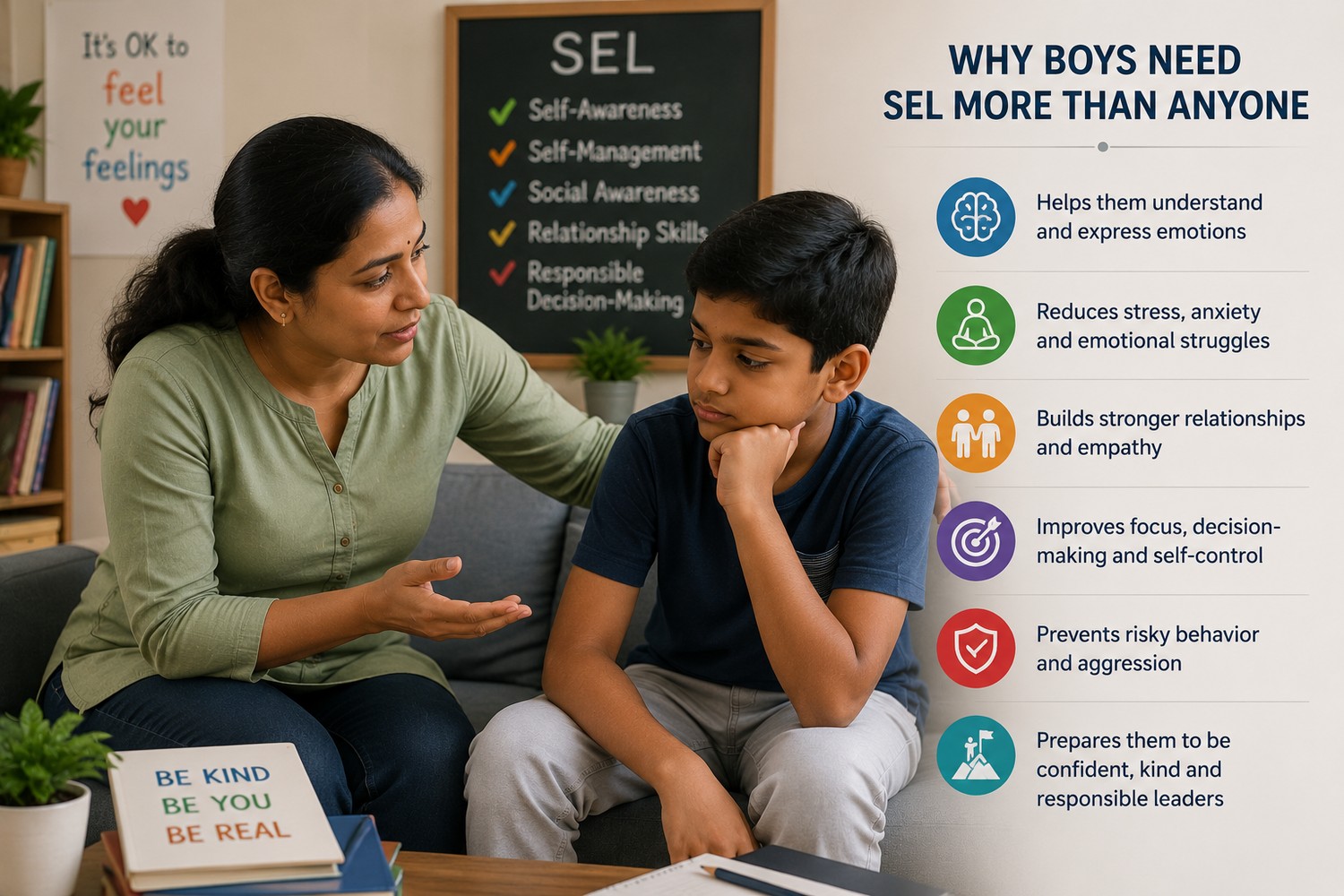
Here's a finding that should reframe the entire conversation about boys and emotion: research on infant emotional expressiveness has found that baby boys are, if anything, more emotionally expressive than baby girls — more reactive, more visibly responsive. The common assumption that boys are simply "naturally" less emotional gets the story backwards from the start.
What actually happens is documented across decades of research by clinical psychologist William Pollack at Harvard Medical School: that early expressiveness gets systematically socialized out of boys as they grow, replaced by what Pollack calls the "Boy Code" — an unwritten set of rules demanding stoicism, self-reliance, and emotional concealment, often beginning as early as preschool.
This distinction matters enormously for how we think about SEL and boys. The goal isn't fixing a deficit boys were born with. It's undoing a socialization process that actively worked against a capacity they already had.
What the "Boy Code" Actually Does
Pollack's research describes a specific, repeated pattern: boys are pushed toward early separation from parental comfort, shamed for expressing fear or sadness, and taught — often through subtle social cues rather than direct instruction — that vulnerability is something to hide behind a "mask of masculinity." The result, in Pollack's own phrasing, is that many boys end up "only allowed to lead half their emotional lives."
This isn't a claim about individual parents doing something wrong. It's a pattern embedded in broader cultural messaging — "boys don't cry," "man up," "walk it off" — absorbed from multiple directions: peers, media, sports culture, and sometimes well-meaning adults trying to prepare a boy for a world they believe will demand toughness from him.
Being Honest About the Research on Emotion Talk
It's worth being precise here rather than overstating the case. Several individual studies, notably from researcher Robyn Fivush and colleagues, found that parents use more emotion words, and discuss sadness and fear more elaborately, with daughters than with sons — a real, replicated pattern in several samples. However, a more recent meta-analysis pooling 34 independent studies and over 3,600 participants found no significant overall difference in how frequently mothers talk about emotions with sons versus daughters.
The honest synthesis: the broad claim that "parents just talk less about feelings with boys, full stop" oversimplifies genuinely mixed evidence. What appears more consistent, across both bodies of research, is something more specific — certain emotions, particularly sadness and fear, get less airtime and less elaboration with boys, even where overall emotional conversation frequency doesn't differ dramatically. It's less about volume and more about which emotions get room to exist.
The Downstream Pattern
Boys who grow up with restricted access to naming and processing certain emotions don't stop having them — the feelings simply find other outlets. Developmental research consistently observes that boys are more often socialized toward externalizing expressions of distress — anger, acting out, physical restlessness — while internalizing emotions like sadness or fear get less validation and less practice being named directly. This isn't because boys feel less. It's because the acceptable exit route for distress has been narrowed to one channel.
This pattern shows up in real, measurable outcomes: boys are disproportionately represented in learning and behavioural disability diagnoses in many school systems, often underperform girls academically across several countries in reading and school engagement specifically, and — this is worth stating with appropriate care rather than statistics — face documented, well-established barriers to seeking help for emotional struggles precisely because help-seeking itself can feel like a violation of the code they've absorbed.
If you're concerned about a child's emotional wellbeing or safety, please reach out to a mental health professional — this article addresses everyday emotional skill-building, not a substitute for clinical support when it's genuinely needed.
Why SEL Specifically Matters as a Countermeasure
Here's the reframe worth holding onto: SEL isn't teaching boys a skill they lack the capacity for. It's actively working against years of socialization that suppressed a capacity they started with. That's a meaningfully different, more hopeful framing than "boys are just less emotionally intelligent" — and it's the one the actual developmental research supports.
What Actually Helps
Name the full emotional range with boys, not just anger. If "frustrated" and "angry" are the only feeling-words regularly offered to a boy, that's the only vocabulary he'll have access to under pressure. Actively introduce and validate sadness, fear, disappointment, and vulnerability with the same frequency you would for any child.
Interrupt "boys don't cry" language directly, including when it comes from other kids or media, not just adults. A simple, repeated counter-message — "everyone's feelings matter, including yours" — does real work over years of repetition, even when a single instance seems too small to matter.
Model male emotional expression visibly. A father, older brother, or male teacher naming a real feeling out loud — "I'm feeling really disappointed about how that went" — teaches a boy that emotional honesty and masculinity were never actually in conflict, far more effectively than any conversation about the concept in the abstract.
Watch for anger as a secondary emotion, not just the primary one. When a boy is expressing anger, gently probe what's underneath it — "are you angry, or is there something else going on too?" — since anger is often the one channel that's remained socially acceptable, masking a different feeling underneath.
Give boys the same emotional processing time and space typically extended to girls, rather than rushing them toward "toughening up" or independence faster than their actual developmental readiness supports.
What to Do This Week
- Notice which feeling-words you use most often with the boys in your life, and consciously introduce ones beyond anger and frustration — disappointment, worry, sadness.
- The next time you hear "boys don't cry" or similar language, even said casually, offer a brief, calm counter: "everyone's feelings are allowed here."
- Model one piece of genuine emotional honesty yourself this week, especially if you're a father, older brother, or male role model in a boy's life — the demonstration teaches more than instruction ever will.
Boys were never born with less emotional capacity. What they've often been given is a narrower, more restrictive set of rules about which parts of that capacity are allowed to show. SEL, done well, isn't correcting a deficiency — it's reopening a door that socialization quietly closed.
Happy Sprout Action: Want your son building genuine emotional fluency, in an environment where the full range of feelings is welcomed rather than narrowed? Register your child for a live Happy Sprout SEL class at happysproutminds.com, guided by a trained facilitator.
Future Starts Within.