
Last week, a mother told me about her son's cricket match. His team lost — badly — and on the drive home he sat in the back seat, silent, arms crossed, staring out the window. She tried the usual things. "It's just a game." "You played well." "Are you hungry, should we stop for something?" Nothing. He didn't say a word until they pulled into the driveway, and then he snapped at his younger sister for touching his water bottle.
Now picture a different kid, same losing match. She's gutted too — you can see it, her shoulders are down, her eyes are red. But somewhere between the parking lot and the front door, she says, "That one really stung. I need ten minutes alone before I talk about it." Then she goes to her room, comes out for dinner, and actually eats.
Nobody taught the second kid to be "better." She's not calmer by nature. She's just had more practice at something specific: figuring out what she's feeling, and doing something useful with it instead of letting it drive.
That something is emotional intelligence in children — and if you're a parent or teacher wondering what it actually is, and how to build it in a real child on a real Tuesday, this guide is for you.
What is emotional intelligence in kids?
Strip away the jargon and emotional intelligence (EQ, for short) comes down to four questions a child slowly learns to answer, almost automatically, several times a day:
What am I feeling right now? Not just "bad." Frustrated? Embarrassed? Left out? These are different problems with different solutions.
Why am I feeling it? The kid who explodes over a wrong answer on a spelling test is rarely upset about the spelling. More often it's "I'm scared I'm not smart enough," and the test just poked at that.
What do I do about it that won't make things worse? This is the ten-year-old who wants to throw his tablet across the room and instead throws himself onto the couch face-first and groans for thirty seconds. Same energy, very different outcome.
Can I read what someone else is going through, too? The friend who notices you've gone quiet at lunch and just sits next to you without asking a single question — that's emotional intelligence in a twelve-year-old's body.
Psychologist Daniel Goleman, who popularized the term in the 1990s, broke it into five pieces that still hold up: self-awareness, self-regulation, motivation, empathy, and social skill. Notice academic ability isn't on that list. When people compare emotional intelligence vs IQ in children, the honest answer is that IQ measures what a child can figure out — EQ measures what they do with what they feel. Both matter. Only one of them is usually left untaught.
Why does emotional intelligence matter for kids?
Here's what nobody tells you: the kid who can't self-soothe can't sit still and do the math worksheet either. The two aren't separate. A child flooded with frustration has almost no working memory left over for long division. Ask any teacher — the "disruptive" kid, the one who "won't focus," is very often the kid who never learned what to do with a feeling once it shows up. The tantrum isn't the problem. It's a symptom of a missing skill.
So when we talk about the importance of emotional intelligence in child development, we're not talking about something in competition with academics, sports, or exam prep. We're talking about the thing that has to be in place before any of that can really land.
How does emotional intelligence develop in children?
EQ isn't one skill — it's a chain, and like any chain, it's only as strong as its weakest link.
Notice → Name → Choose. First a child has to notice a feeling is happening at all (a lot of kids skip straight to the reaction without ever registering "oh, I'm anxious"). Then they need a word for it — "frustrated" and "embarrassed" can both feel like a hot, tight chest in the moment, but they call for very different responses. Only once it's named can a child actually choose a response instead of just reacting.
This is why a child mid-meltdown can't be reasoned with — they're stuck at "notice," flooded, with no bandwidth left to name or choose anything. It's also why age-appropriate emotional intelligence skills look different at six than at sixteen: a six-year-old is still building the vocabulary; a sixteen-year-old is refining the choosing. The fix isn't a lecture in the heat of the moment. It's building the habit of noticing and naming in calm moments, so it's already there when things get hard.
What does the research say about emotional intelligence in children?
This isn't just a nice idea — it's been studied for decades. Goleman's original argument was that IQ gets a person in the door, but EQ determines how far they get once inside, and later research has largely backed that up: children's self-regulation and social skills in the early grades reliably predict academic achievement, peer relationships, and mental wellbeing years later — often more strongly than IQ alone does.
Programs built around Social-Emotional Learning — the umbrella term schools use, often shortened to SEL — have also been studied at scale. The consistent finding, across large reviews of hundreds of programs, is that kids who get structured practice with these skills tend to do measurably better academically, report fewer behavioral problems, and describe better relationships with peers and teachers, often within the same school year, not years later.
The short version: social emotional learning for parents and teachers isn't soft, and it isn't optional. It's one of the more evidence-backed levers we have for how a child does in school and beyond.
Common mistakes parents and teachers make with emotional intelligence
Jumping to the fix before the feeling is heard. "It's okay, you'll do better next time" lands as dismissal, not comfort, if it arrives before anyone's acknowledged that the moment actually hurt.
Treating big reactions as a discipline problem first. Sending a child straight to a consequence for a meltdown, without a beat to ask what happened underneath it, teaches them to hide the feeling next time — not to handle it.
Only talking about feelings during a crisis. If "let's talk about what you're feeling" only ever shows up after something's gone wrong, kids start to associate emotional talk with trouble, not with normal life.
Rescuing every uncomfortable moment. Handing a bored or sulky child a screen the second they're uncomfortable is kind in the moment, but it quietly removes the exact practice they need — sitting with a feeling long enough to work out what to do with it.
Assuming this happens automatically with age. Plenty of adults are still working on their own EQ. Kids don't outgrow poor regulation on their own — they need repeated, low-stakes practice, the same way they need practice with reading or times tables.
Expert recommendations for building emotional intelligence
Educators and child psychologists tend to converge on a few practical habits for how to teach emotional intelligence to children:
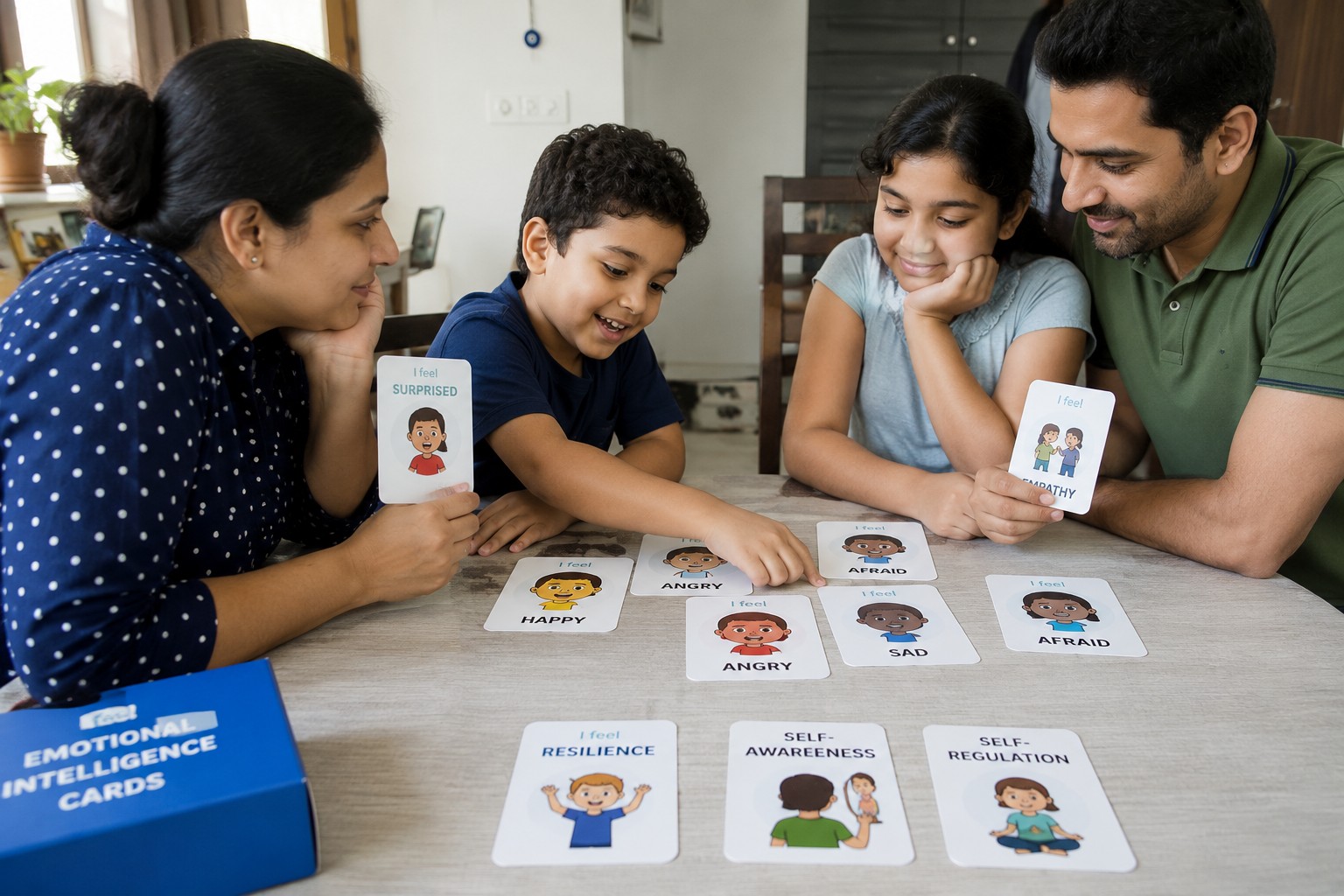
- Build a feelings vocabulary early and often — not just "happy, sad, angry" but the fuller range: frustrated, embarrassed, disappointed, proud, nervous. Kids can't regulate what they can't name.
- Model regulation out loud, rather than lecturing about it. Kids absorb far more from watching an adult say "I'm frustrated, I'm going to take a breath" than from any talk about staying calm.
- Use a short pause before consequences. A brief "let's figure out what happened" before addressing behavior teaches more than the consequence alone.
- Normalize regular emotional check-ins, so they're routine, not a response to crisis — a one-word check-in at the start of class or dinner works fine.
- Treat friction as the lesson, not a distraction from it. The playground argument or the group-project disagreement is often a better classroom for EQ than any worksheet about it.
Real-world examples of emotional intelligence in children
In the classroom: A teacher notices two students glaring at each other over who gets to glue the poster together. Instead of separating them and moving on, she gives them ninety seconds: "Tell each other one thing you're annoyed about, and one thing you actually want." It's clumsy, they're twelve, but it works better than either a scolding or a rule change — because it practices the actual skill instead of just suppressing the symptom. This is what emotional intelligence in the classroom looks like in practice — small, unglamorous, repeated.
At home: A child gets a disappointing grade and says, "I'm just bad at this." Instead of arguing back with "no you're not, you're smart," a parent says, "That grade really stung, didn't it." More often than not, the "I'm bad at this" softens on its own once the child feels heard — arguing with the thought first just makes them defend it harder.
Between friends: A student notices a classmate eating lunch alone, unusually quiet, and instead of asking "what's wrong?" in front of everyone, just sits down next to them without a word. That instinct — reading a feeling and responding to it without needing it spelled out — is one of the clearest signs of emotional intelligence in a child. It rarely gets praised, but it's exactly the skill we're talking about.
What should you do next?
You don't need a formal program of emotional intelligence activities for kids to start. You need three things, repeated:
- This week, name a feeling out loud in front of your child or class — including your own, even a small one like "I'm a bit rattled today." It's a small habit that teaches emotional vocabulary just by being heard.
- Next time a child reacts badly, pause before you get to the consequence. Ask what happened underneath it first. It takes ten extra seconds and changes what the moment teaches.
- Swap one routine question for a better one. "How was school" becomes "what was the best part of your day, and was there a hard part too." "Are you okay" becomes "what are you feeling right now, in one word." Small changes, repeated often, are how you build emotional intelligence at home and in the classroom, one rep at a time.
None of this requires a special kind of child, a perfect parent, or a formal curriculum. It grows in the ordinary, slightly irritating moments that already happen — the lost match, the bad grade, the sibling squabble over a water bottle. The only real ingredient is practice.
That's the whole idea we build Happy Sprout around. Emotional intelligence isn't a chapter you finish. It's a muscle — one small rep at a time, at school and at home, together.
Future Starts Within.