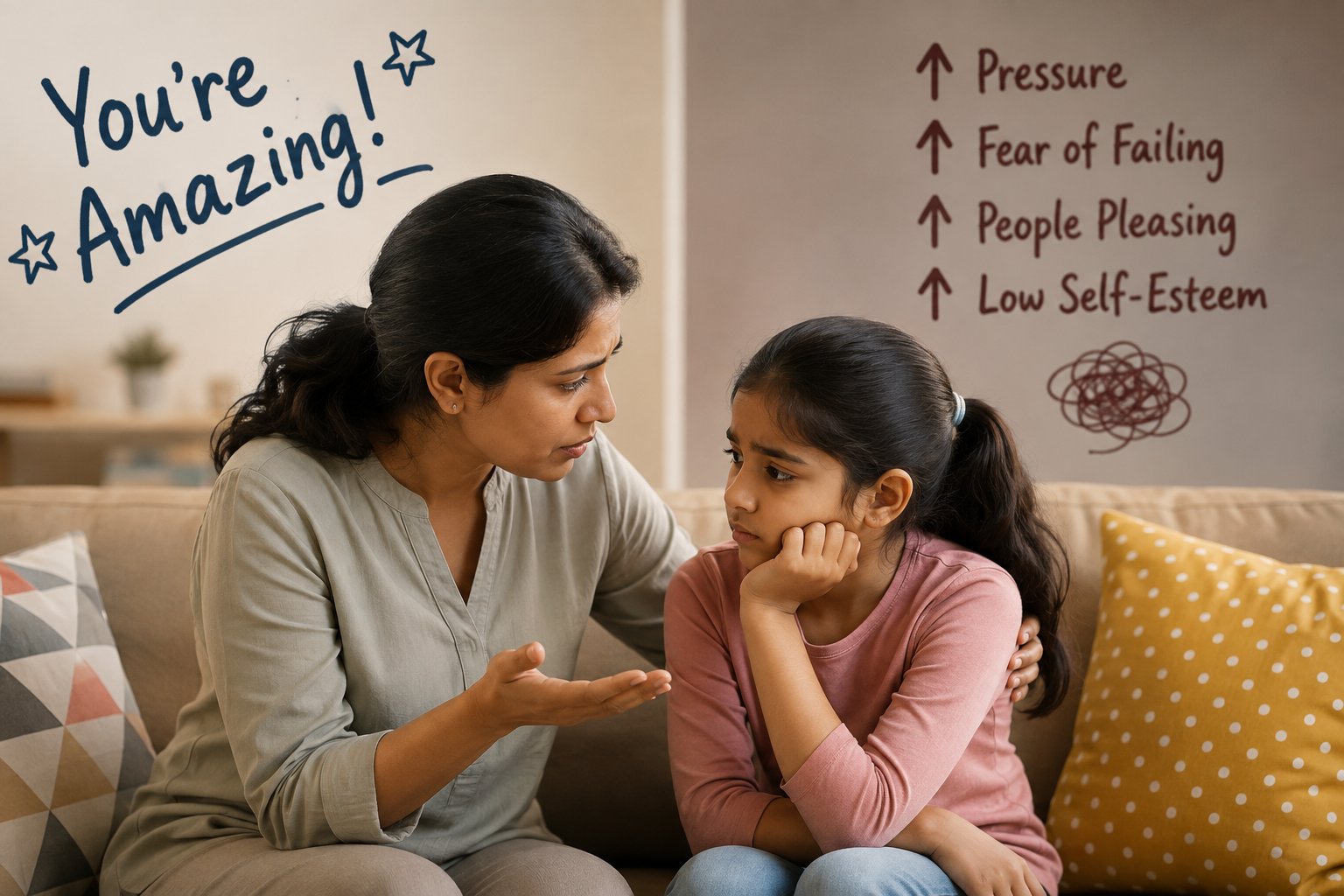
A longitudinal study of 120 parent-child pairs in the Netherlands, tracking children through the exact years — ages 7 to 11 — when self-esteem and narcissism first take shape, found something that directly contradicts the instinct behind most well-meaning parenting: parents' inflated praise predicted lower self-esteem in their children, not higher. Not neutral. Lower. The praise intended to build confidence was quietly working against it.
Psychologist Eddie Brummelman and colleagues, who conducted this research along with a related landmark study published in the Proceedings of the National Academy of Sciences, have spent over a decade mapping exactly why this happens — and the findings should genuinely reshape how parents think about praise.
What Actually Counts as "Inflated" Praise
Here's the specific, almost unsettling detail from Brummelman's research: it takes remarkably little to inflate a compliment. A single added adjective or adverb — "that's not just beautiful, that's incredibly beautiful," "that's not just good, that's the best drawing I've ever seen" — is enough to shift ordinary, accurate praise into inflated territory. Most parents offering this kind of praise have no idea they've crossed a meaningful line, because the shift feels like simple enthusiasm, not a different category of feedback.
Why Inflated Praise Backfires: The Self-Deflation Mechanism
The research supports what Brummelman calls the self-deflation hypothesis: inflated praise sets a standard the child then has to live up to — and when reality inevitably falls short of "the best drawing I've ever seen," the gap between the praise and the child's own honest self-assessment becomes the problem, not the solution. A separate study by the same research team found this effect is particularly damaging for children who already have lower self-esteem — inflated praise raises the bar exactly for the children least equipped to feel they can clear it.
Here's the part that connects directly to self-awareness specifically, not just self-esteem: inflated praise teaches a child to distrust their own read of a situation. A child who's told their merely-decent drawing is "the most amazing thing ever" learns, over repeated exposure, that adult feedback doesn't reliably track reality — which quietly undermines the exact skill self-awareness depends on: an accurate, trustworthy internal sense of one's own actual performance and abilities.
The Crucial Distinction: Overvaluation vs. Warmth
Brummelman's PNAS study, following 565 Dutch children ages 7 to 12, tested two competing theories about where childhood narcissism actually comes from: a lack of parental warmth, or the opposite — parents treating their child as more special and entitled than others (what the researchers call parental overvaluation). The results were clear: narcissism was predicted specifically by overvaluation, not by a lack of warmth. Meanwhile, healthy self-esteem was predicted by parental warmth — a completely separate dimension.
This distinction matters enormously in practice, because it means the fix isn't "praise your child less" — that risks removing genuine warmth, which the research shows is protective. The fix is separating warmth from overvaluation — being genuinely warm, present, and affectionate, while being honest and specific rather than inflated about actual performance and ability.
Overvaluing parents, per this research, tend to believe their child is smarter than others even when test scores say otherwise, and praise consistently regardless of whether the child actually performed well. The praise stops being information and becomes noise — which is precisely what erodes a child's ability to build accurate self-knowledge.
What Realistic, Warm Praise Actually Sounds Like
Instead of: "You're the smartest kid in your class!" Try: "You worked really hard on understanding that, and it shows."
Instead of: "That's the best drawing I've ever seen in my life!" Try: "I love the colors you chose here — tell me about this part."
Instead of: "You're perfect." Try: "I love you exactly as you are." (Warmth, without an inflated performance claim attached.)
Instead of: "You're a natural, you didn't even have to try!" Try: "You really stuck with that even when it got hard."
Instead of: "Nobody else could have done that as well as you." Try: "You should feel proud of that — you did it."
Notice the pattern: warmth stays constant across every alternative. What changes is specificity and accuracy — the praise reflects something genuinely true and observable, rather than an inflated, comparative, or superlative claim the child's own experience can't actually verify.
What to Do This Week
- Notice your own inflated adjectives and adverbs this week — "incredible," "the best ever," "perfect" — and consciously swap them for specific, accurate observations instead.
- Keep the warmth, drop the overvaluation. A hug and "I love you" carries none of the risk inflated performance praise does — affection and accurate feedback aren't in competition.
- When your child does something genuinely impressive, describe what you actually observed rather than reaching for a superlative — "you figured that out on your own" beats "you're a genius" every time.
The confidence most parents are actually trying to build was never going to come from telling a child they're amazing. Real, durable self-worth comes from something considerably less flashy: consistent warmth, paired with feedback a child can actually trust.
Happy Sprout Action: Download our free Self-Aware Praise Framework — 15 praise templates that build genuine self-knowledge instead of fragile validation — and register your child for a live Happy Sprout SEL class at happysproutminds.com, guided by a trained facilitator.
Future Starts Within.