
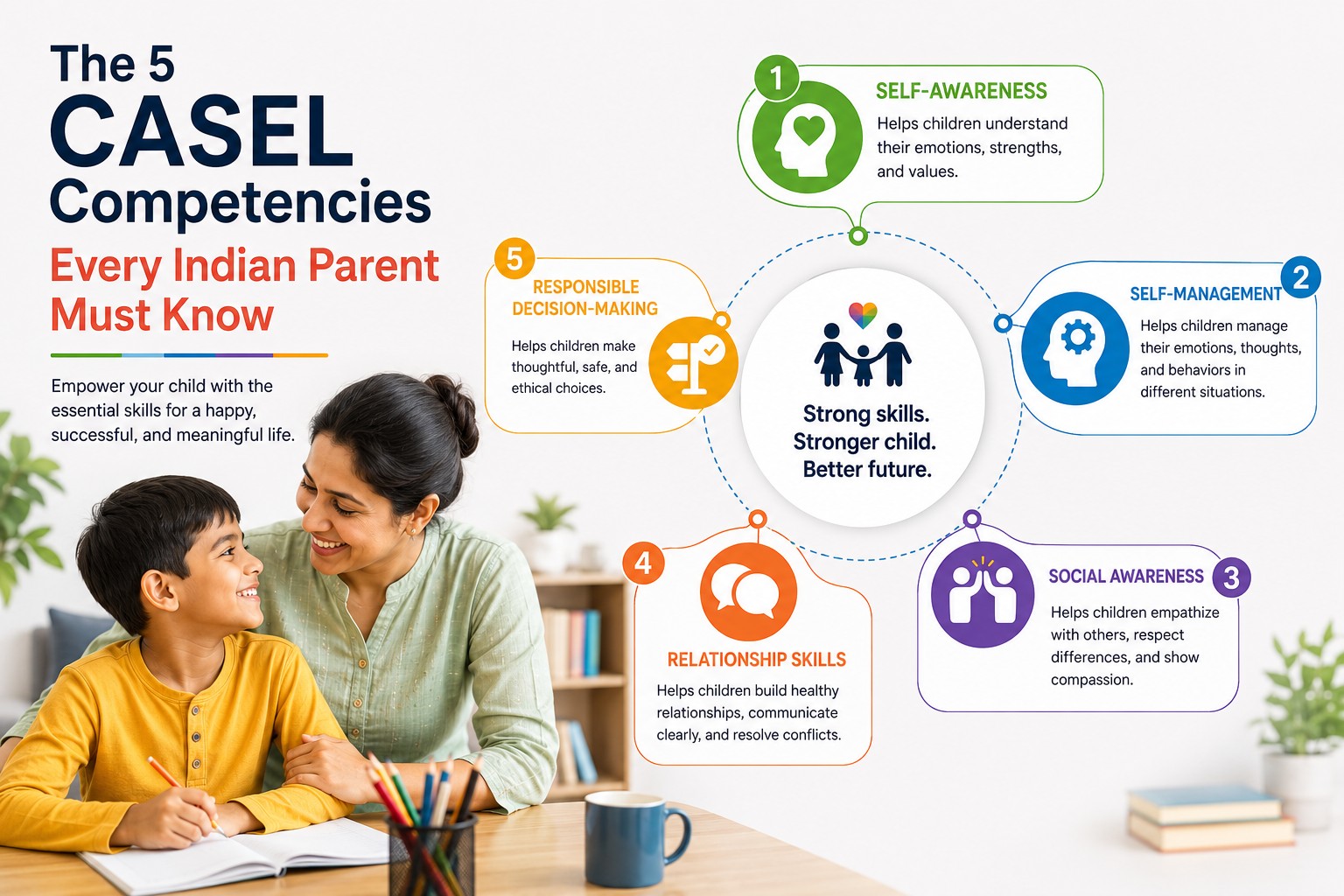
Here's a question worth sitting with: could you name the five specific skills that determine whether your child grows into someone who can manage stress, hold a friendship, and make a good decision under pressure?
Most parents can't. Not because they don't care — because nobody ever handed them the list.
CASEL — the Collaborative for Academic, Social, and Emotional Learning — has spent decades building exactly that list. It's the most widely used SEL framework in the world, informing state education standards and school curricula across dozens of countries. And yet it remains almost completely unknown among Indian parents, despite NEP 2020 explicitly requiring schools to build these exact competencies into how children are educated.
So let's fix that. Here's the complete breakdown of all 5 CASEL competencies — and a real, practical way to build each one in an Indian home, starting tonight.
Competency 1: Self-Awareness — Helping Your Child Know Themselves
The definition: the ability to understand your own emotions, thoughts, and values — and to see how they shape your behaviour.
Here's why this one comes first: a child who can't identify what they're feeling can't regulate it, communicate it, or make a decision based on it. Every other competency on this list is downstream of self-awareness. Skip this one, and the rest becomes much harder to build.
How to build it at home: Run a simple evening check-in. Ask your child to name how they felt at three points in the day — morning, lunchtime, evening. That's it. Do it consistently, and their emotional vocabulary expands almost on its own, the same way any vocabulary grows through repeated use.
India-specific activity: For older children, try using the Navarasas — the nine emotional states from classical Indian aesthetics (Shringara, Hasya, Karuna, Raudra, Vira, Bhayanaka, Bibhatsa, Adbhuta, Shanta) — as an advanced emotional vocabulary tool. It's a genuinely rich framework that predates most Western emotion-labeling models by centuries, and it gives kids far more precision than "happy, sad, angry."
Competency 2: Self-Management — Teaching Impulse Control Without Nagging
The definition: the ability to regulate your emotions, thoughts, and behaviour across different situations — managing stress, controlling impulses, setting goals, staying motivated.
Here's the stat that should get your attention: longitudinal research following the original Stanford "marshmallow test" cohort (Mischel and colleagues) found that children who showed stronger impulse control at age 4 tended to show better health, financial stability, and relationship outcomes decades later, in midlife. Separate long-term studies, including the well-known Dunedin cohort research, have found similar links between early self-control and outcomes across health, wealth, and even legal trouble, tracked from early childhood into adulthood. (Worth knowing: some of this research has faced replication challenges once family background is controlled for — but the broad direction of the finding has held up across multiple independent studies.) Even accounting for that nuance, self-management remains one of the highest-leverage skills you can invest in early.
How to build it at home: Build a "cool-down kit" together — a small box with a stress ball, a card listing 3 breathing exercises, and a list of 5 things that help your specific child calm down. The key detail: let your child design it themselves. A tool a child builds is a tool a child actually reaches for. A tool imposed on them usually gets ignored.
Competency 3: Social Awareness — Building Empathy in a Competitive Culture
The definition: the ability to take someone else's perspective and empathise with them — including people from backgrounds very different from your own.
Here's the uncomfortable part for Indian parents specifically: in a culture built around intense competition for marks and university seats, social awareness is often the first thing sacrificed. The result, further down the line, is highly intelligent adults who struggle to collaborate, lead, or sustain relationships — exactly the gap employers keep reporting when they say technical graduates lack the interpersonal skills the job actually needs.
How to build it at home: Read books together featuring protagonists from different backgrounds, religions, and economic situations. After each chapter, ask two questions: "What do you think the character was feeling?" and "What would you have done?" Both questions do real work — the first builds empathy, the second builds perspective-taking under a hypothetical, which is exactly the muscle social awareness depends on.
Competency 4: Relationship Skills — The Art of Connection
The definition: clear communication, active listening, cooperation, resisting inappropriate peer pressure, and resolving conflict constructively.
This is consistently the competency employers name when they describe what's missing in otherwise strong candidates: technically sharp, but unable to navigate a disagreement without it becoming personal.
How to build it at home: Teach your child the DEAR framework for difficult conversations — a simplified version of a tool used in clinical communication training:
- Describe the situation, factually, without blame.
- Express your feelings about it.
- Assert what you actually need.
- Reinforce why it matters.
The real teaching moment isn't a lecture about DEAR. It's using it yourself, out loud, during real family conflicts — so your child watches the framework in action rather than just hearing about it in the abstract.
Competency 5: Responsible Decision-Making — Ethics Over Peer Pressure
The definition: making constructive choices about your own behaviour and social interactions, grounded in ethical standards, safety, and social norms — even when it's inconvenient or unpopular to do so.
How to build it at home: Run ethical dilemma conversations at the dinner table. Something like: "Your friend copied off someone during an exam, got caught, and blamed the person whose paper they copied. What do you think about that?"
Here's the key move: there's no right answer you're steering toward. The value isn't in your child landing on the "correct" moral conclusion — it's in the muscle of actually reasoning through a grey-area situation out loud, with you, in a low-stakes setting, long before they face a real version of it without you in the room.
Putting It All Together
Five competencies, five starting points:
- Self-Awareness → the evening three-point feelings check-in
- Self-Management → the child-designed cool-down kit
- Social Awareness → the "what were they feeling" book discussion
- Relationship Skills → the DEAR framework, modeled during real conflict
- Responsible Decision-Making → the dinner-table ethical dilemma
Don't try to build all five at once. Pick the one competency where your child currently struggles most, and run that single activity consistently for two to three weeks before adding the next.
Happy Sprout's complete CASEL-aligned curriculum covers all 5 competencies across Grades 1–10. Download our free parent handbook at happysproutminds.com.
Future Starts Within.