
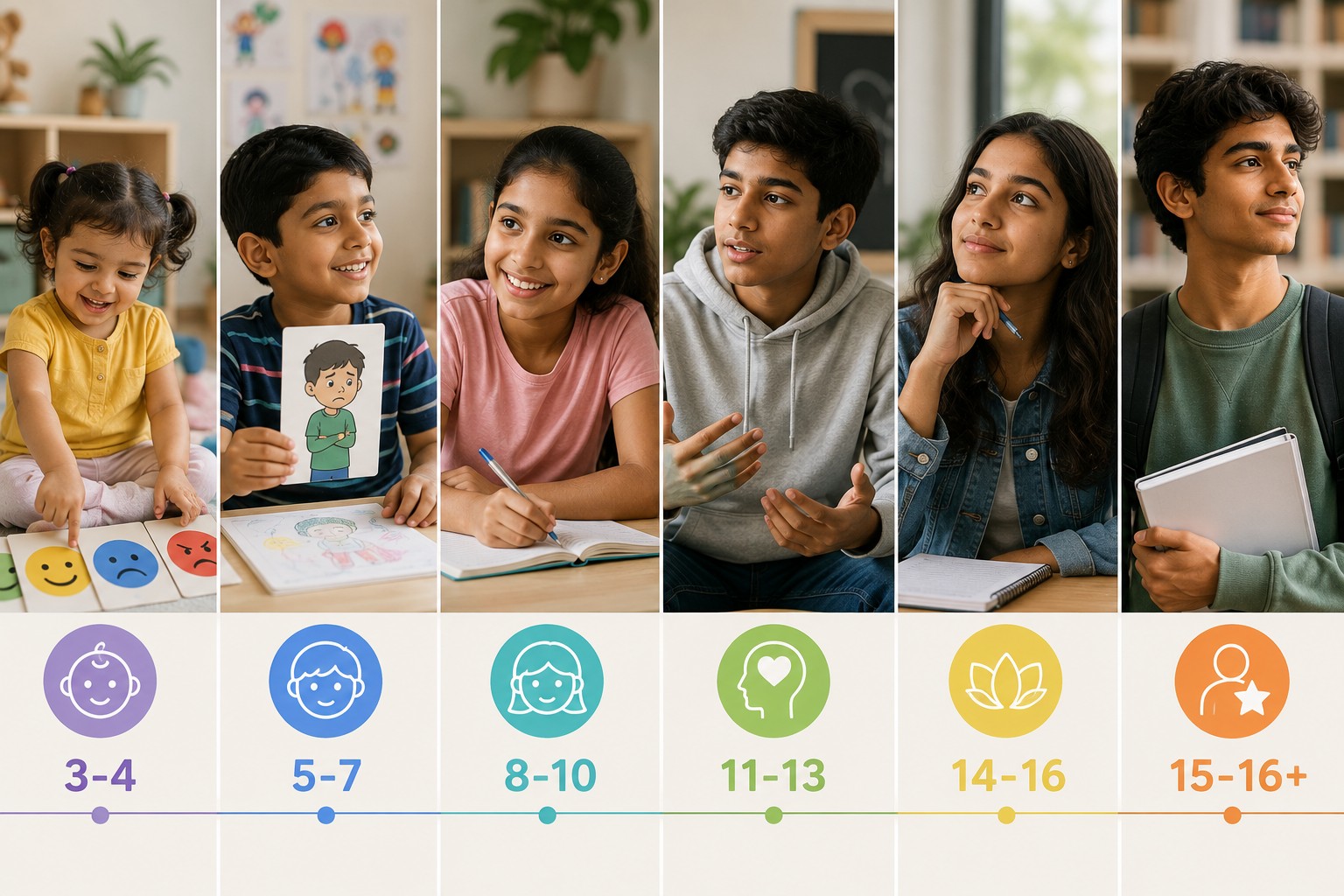
Here's a mistake that quietly undermines a lot of well-intentioned emotional coaching: expecting a child to understand something their brain genuinely isn't developmentally ready for yet. Asking a four-year-old to hold two conflicting feelings at once, or expecting a nine-year-old to grasp identity-linked emotional nuance a teenager is only just beginning to access — these aren't failures of teaching. They're mismatches between the lesson and the developmental stage.
Developmental psychologist Carolyn Saarni's influential research on emotional competence identified eight distinct skills that build progressively across childhood — not all at once, and not in the order a parenting book might assume. Here's a genuine developmental map, stage by stage, so you know what to actually expect and teach at each age, rather than guessing.
Ages 3–4: Basic Emotion Labels, Limited Regulation
What's developmentally normal here: A child at this age can typically name a small handful of basic emotions — happy, sad, mad, scared — but doesn't yet reliably connect a specific cause to a specific feeling. Emotional regulation capacity is genuinely minimal; a meltdown over a broken cracker isn't manipulation or poor discipline, it's the honest ceiling of what a three- or four-year-old's brain can currently manage alone.
What to focus on: Simple labeling ("you seem sad"), co-regulation (calming with your child rather than expecting them to calm alone), and modeling basic feeling words constantly in ordinary conversation. Emotional contagion is still strong at this age — a child this young absorbs the emotional tone of the room more than they consciously process it, which is exactly why a calm adult presence does more good than any explanation.
Ages 5–6: Self-Conscious Emotions Emerge
What's developmentally normal here: This is roughly when children begin to genuinely grasp more complex, self-referential emotions — pride, guilt, embarrassment, shame — feelings that require a developing sense of self and an awareness of how one is perceived by others. Before this stage, these emotions are largely inaccessible in any real conceptual sense; a three-year-old can act embarrassed without truly understanding the concept the way a six-year-old is beginning to.
What to focus on: This is a genuinely good window to start naming these more complex emotions specifically — "I think you felt proud when you finished that" — because the underlying cognitive capacity to actually grasp them is just becoming available.
Ages 7–9: Understanding Mixed and Simultaneous Emotions
What's developmentally normal here: Research on children's emotional understanding — notably work associated with psychologist Susan Harter — has found that the ability to grasp holding two different feelings about the same thing at once ("I'm excited about the trip AND nervous about leaving my dog") typically develops through this stage, not before it. Younger children tend to understand emotions as one-at-a-time, mutually exclusive states; this age band is roughly when that starts to shift toward genuine emotional complexity.
What to focus on: This is the right window to introduce the specific idea that two feelings can coexist — a concept that would likely confuse a five-year-old but genuinely lands with a seven- or eight-year-old. Naming mixed feelings explicitly ("you can feel happy for your friend and a little jealous, both at once") gives language to something the child may only just be starting to sense internally.
Ages 8–10: Display Rules and the "Emotional Front"
What's developmentally normal here: Saarni's research specifically identified this stage as when children begin learning display rules — the social understanding that what you express doesn't always have to match what you actually feel. A child learns, often without being explicitly taught, that you smile and say thank you for a gift you didn't like, or that crying in front of certain peers carries a social cost worth managing. Saarni referred to this capacity as developing an "emotional front."
What to focus on: This is a genuinely important stage for an honest conversation about the difference between healthy social tact (being polite about a gift) and unhealthy emotional suppression (never admitting you're struggling to anyone). Left unaddressed, children at this age can swing too far toward masking real distress simply because they've just learned they're capable of doing so convincingly.
Ages 10–12: Social Comparison and Peer-Referenced Emotion
What's developmentally normal here: Emotional experience becomes increasingly shaped by social comparison — how a child feels about a situation starts to depend heavily on how they perceive their peers are doing in the same situation, not just the situation itself. A decent grade can feel disappointing if peers scored higher; a modest achievement can feel wonderful if it's seen as impressive relative to the group.
What to focus on: Helping a child notice when a feeling is coming from the actual event versus from comparison to someone else is a genuinely useful, age-appropriate skill at this stage — not because comparison itself is avoidable, but because naming the mechanism reduces its grip.
Ages 13–16: Abstract, Identity-Linked, and Existential Emotion
What's developmentally normal here: Adolescence brings the cognitive capacity for genuinely abstract emotional reasoning — feelings tied to identity ("who am I, really"), values, and even early existential questions, in a way younger children's more concrete thinking simply couldn't support. Emotional experience becomes layered with self-concept in a way it wasn't before; a criticism doesn't just sting in the moment, it can feel like it says something about who the teenager fundamentally is.
What to focus on: This is the stage for values-based, identity-aware emotional conversations — not simplified feeling wheels, which can feel genuinely patronizing by this point, but real discussion about how a feeling connects to what a teenager believes and who they're becoming.
Why the Mismatch Matters More Than It Seems
Here's the practical cost of skipping this developmental map: teaching below a child's actual stage feels boring and disengaging; teaching above it feels confusing and inaccessible. Both failure modes get misread the same way by adults — "my child doesn't care about this" — when the real issue is usually a mismatch between the content and where the child's emotional understanding genuinely sits.
What to Do With This Map
- Identify your child's actual age band from the list above, and notice whether your current approach to talking about feelings actually matches what they're developmentally ready for.
- If your child is approaching a new stage — say, moving from 6 toward 8 — start introducing the next stage's concept gently, since development isn't a hard switch but a gradual widening of capacity.
- Revisit this map periodically. A framework that worked beautifully for your child at seven may start to feel babyish by nine, and that shift is worth noticing rather than defaulting to the same approach out of habit.
Teaching a child about emotions was never a single lesson delivered once. It's a map that has to be redrawn every couple of years, as a child's actual capacity to understand feelings genuinely expands.
Happy Sprout Action: Want your child learning emotional skills that are genuinely matched to their developmental stage, not a one-size-fits-all approach? Register your child for a live Happy Sprout SEL class at happysproutminds.com — our curriculum is age-calibrated across Grades 1–10, guided by a trained facilitator.
Future Starts Within.