
Clinical psychology has a specific, somewhat technical term worth knowing: transdiagnostic risk factor — something that raises risk across multiple, seemingly different mental health conditions rather than just one. Poor emotion regulation is one of the field's most consistently identified transdiagnostic risk factors. It shows up as a contributing mechanism in anxiety, in depression, and in several other conditions that, on the surface, look nothing alike.
That single fact reframes what SEL is actually doing when it teaches a child to manage their emotions. It isn't a soft, general wellness activity running alongside mental health. It's targeting one of the specific mechanisms researchers have identified as a genuine risk factor for developing anxiety and depression in the first place.
The Mechanism: What the Research Actually Identifies
A large, influential meta-analysis by Aldao, Nolen-Hoeksema, and Schweizer examined emotion regulation strategies across a wide body of research and found a consistent pattern: certain regulation strategies are reliably associated with higher rates of psychopathology, and others are reliably associated with lower rates — a distinction that holds up across anxiety, depression, and several other conditions, not just one.
Two specific strategies are worth understanding directly, because they explain a great deal of what SEL is actually trying to build.
Rumination — repetitively dwelling on a distressing thought without moving toward resolution — is one of the most robust predictors of depression identified in the psychological literature. This finding comes largely from psychologist Susan Nolen-Hoeksema's decades of research on what she termed "response styles theory": people who respond to distress by dwelling on it, rather than engaging with it or distracting productively, show significantly higher rates and duration of depressive episodes.
Cognitive reappraisal — reinterpreting a distressing situation in a way that changes its emotional impact — shows the opposite pattern. People who reappraise consistently, rather than ruminate or suppress, show meaningfully better mental health outcomes across the same body of research.
Here's why this matters for parents and schools directly: rumination and reappraisal are both learnable patterns, not fixed traits. A child isn't simply born a ruminator or a reappraiser. These are habits of mind, shaped substantially by what a child is taught and modeled, which means they're squarely within the reach of deliberate SEL instruction.
Why This Reframes What SEL Is Actually Doing
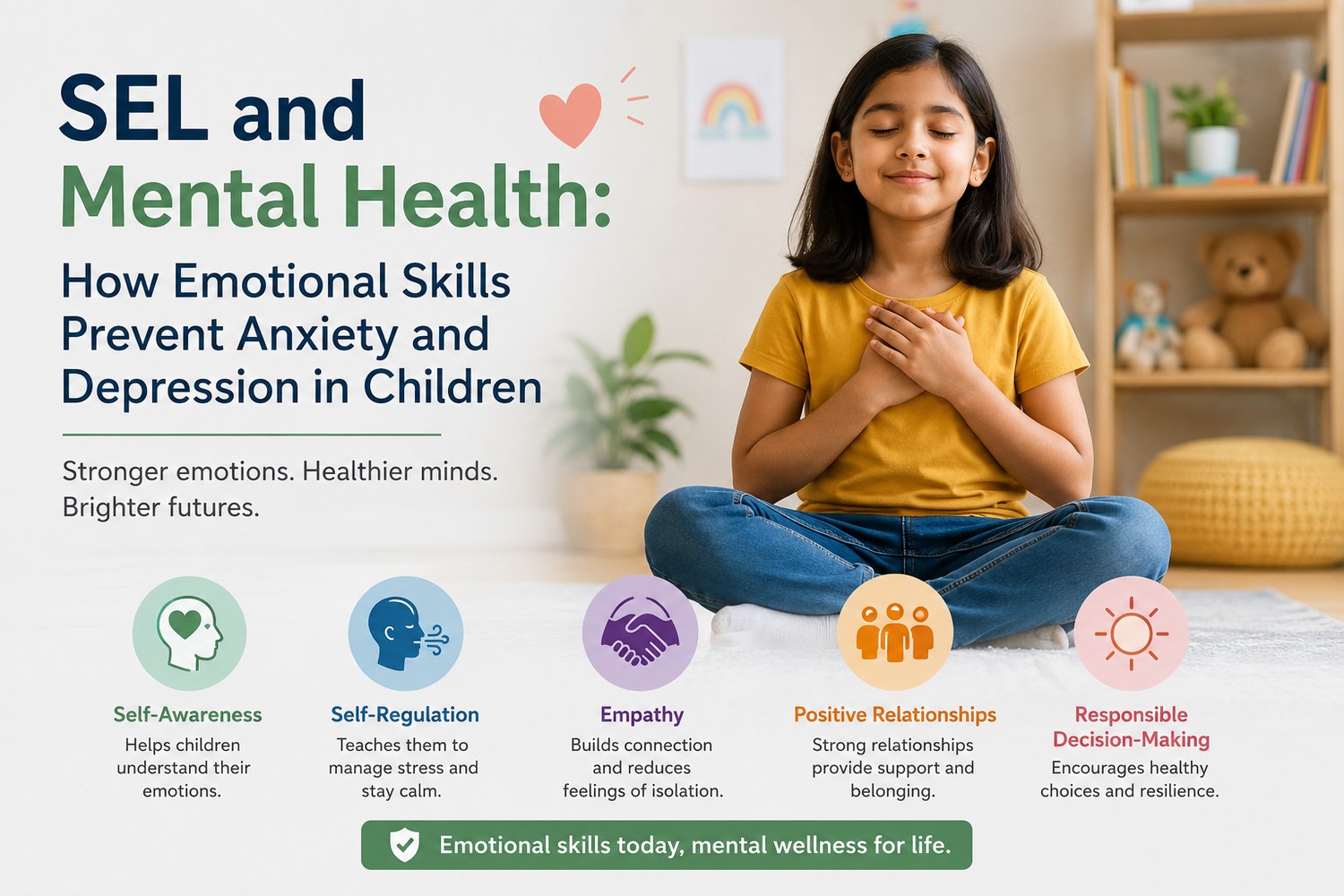
Self-awareness — noticing a feeling as it arises rather than being swept into it — is the first step that makes reappraisal possible at all; you can't reinterpret a feeling you haven't yet noticed you're having. Self-management — the CASEL competency most directly tied to emotion regulation — is essentially reappraisal and healthy coping, taught explicitly rather than left to develop by chance.
This is a genuinely different argument than "SEL improves wellbeing generally." It's the more specific claim that SEL instruction targets the exact regulation strategies clinical research has identified as protective against two of the most common mental health conditions children face.
Being Honest About the Prevention Program Evidence
It's worth being direct about something many articles on this topic skip: not every school-based prevention programme built around these principles has shown consistent results. The Penn Resiliency Program, a well-known cognitive-behavioral prevention curriculum developed by researchers including Martin Seligman, has a genuinely mixed evidence record. One meta-analysis, pooling 17 controlled trials, found it significantly reduced depressive symptoms through at least one year post-intervention. A separate, more recent systematic review found no significant evidence of the programme reducing depression or anxiety across nine controlled trials.
This isn't a reason to dismiss the underlying mechanism — the emotion-regulation research behind rumination and reappraisal remains robust and well-replicated. It's a reason to be honest that packaging that mechanism into a specific standalone curriculum, delivered at scale, doesn't automatically guarantee the same protective effect found in more controlled research settings. Programme quality, delivery consistency, and dosage appear to matter enormously — a pattern that echoes findings across school-based intervention research more broadly, not just this specific programme.
What Actually Helps, Practically
Teach reappraisal directly, as a specific skill, not just "think positive." The difference matters: reappraisal means genuinely reconsidering what a situation means — "maybe this mistake shows me what to practise, not that I'm bad at this" — not simply forcing a cheerful gloss over real distress.
Interrupt rumination early, without dismissing the underlying feeling. If a child is stuck replaying the same distressing thought repeatedly, gently redirect toward either problem-solving ("what's one thing you could actually do about this?") or a genuine change of activity — not by telling them to stop thinking about it, which rarely works on its own.
Build self-awareness as the foundation everything else depends on. A child who can't yet notice "I'm ruminating right now" can't apply reappraisal to interrupt it — which is why self-awareness instruction isn't a separate, lower-priority skill, but the prerequisite for the mental-health-protective skills built on top of it.
Model reappraisal out loud, specifically. "That didn't go the way I wanted, but let me think about what I can actually take from it" demonstrates the exact cognitive move research links to better mental health outcomes — far more effectively than any lesson about it delivered in the abstract.
What to Do This Week
Notice when your child is ruminating versus genuinely processing a feeling — the difference is whether the thinking is moving toward any resolution or simply repeating — and gently redirect the former toward either problem-solving or a genuine break.
Practise reappraisal together after a real setback this week, out loud: "what's one different way to think about what just happened?"
Remember that self-awareness comes first. If your child struggles to even notice they're stuck in a difficult thought pattern, start there before expecting reappraisal to work.
This isn't a claim that SEL prevents all mental health struggle — no single intervention does, and any framing that promises that overreaches. It's a narrower, better-supported claim: the specific skills SEL instruction builds — self-awareness, reappraisal, healthy coping — are the same skills clinical research has identified as protective factors against two of the most common conditions children face. That's a genuinely strong reason to take emotional skill-building seriously, without needing to oversell it as a cure.
Happy Sprout Action: Want your child building genuine emotion regulation skills — the same mechanisms this research points to as protective — through structured, guided practice? Register your child for a live Happy Sprout SEL class at happysproutminds.com, guided by a trained facilitator.
Future Starts Within.
If you're concerned your child may be experiencing anxiety or depression beyond what everyday emotional skill-building can address, please consult a mental health professional — SEL is a valuable protective and preventive tool, not a substitute for clinical care when it's genuinely needed.