
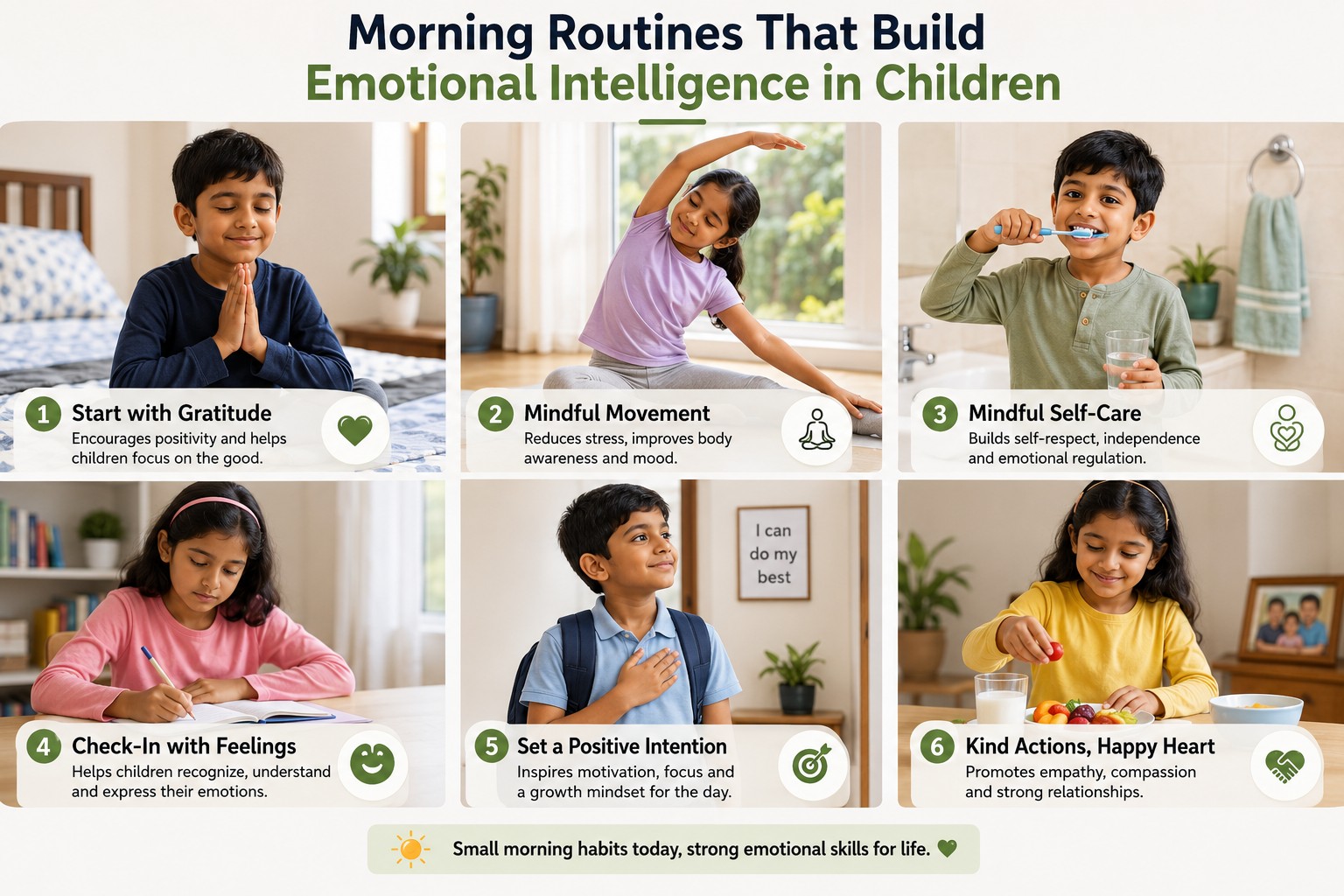
Here's a pattern most parents recognize but rarely name: the first fifteen minutes of your child's day quietly set the emotional tone for the next eight hours.
A rushed, chaotic, phone-scrolling morning sends a child into school already dysregulated — before a single class has started. A calm, connected fifteen minutes does the opposite: it gives your child's nervous system a stable starting point to return to when the school day inevitably throws something hard at them.
This isn't about waking up earlier or adding more to an already packed schedule. It's about restructuring the fifteen minutes you're already spending — into something that actually builds emotional skills instead of just getting everyone out the door.
Here's the exact blueprint.
Why the Morning Specifically Matters
Children's stress-response systems are highly sensitive to how a day begins, not just to what happens during it. A morning spent being nagged, rushed, and half-listened-to primes a child's nervous system toward reactivity before the first bell even rings. A morning that includes even a few minutes of genuine connection does the opposite — it's why researchers in attachment and self-regulation consistently point to the same principle: connection has to come before correction, and the earlier in the day that connection happens, the more it shapes everything after it.
This matters even more in Indian households specifically, where mornings are often the most logistically chaotic part of the day — school buses, tiffin's, uniforms, multiple children on different schedules. The instinct is to strip anything "extra" out of a rushed morning. The research suggests the opposite: a few minutes of structured connection is exactly what a chaotic morning needs, not what it can afford to cut.
The 15-Minute EQ Morning Blueprint
Here's a minute-by-minute structure you can adapt to your own household's rhythm. The order matters more than the exact timing — each step builds on the one before it.
Minutes 0–2: Connection Before Correction. Before a single instruction about uniforms, breakfast, or the school bus, make eye contact and greet your child by name, warmly, with full attention — no phone in your hand. In many Indian households, this is also a natural moment for a values-based ritual already built into the culture, like touching an elder's feet for blessings. The content of the ritual matters less than the fact that it's the very first interaction of the day, and it's about connection, not correction.
Minutes 2–5: The Feelings Weather Report. Ask a simple question: "What's the weather like inside you this morning — sunny, cloudy, stormy?" This takes thirty seconds but does real work — it's a self-awareness check-in that also tells you, as a parent, whether your child is walking into the day already carrying something heavy.
Minutes 5–9: Breakfast With One Real Conversation. Not a debrief of yesterday's homework. One genuine question: "What are you looking forward to today?" or "Is there anything about today that feels a bit hard?" This is where self-management quietly gets built — a child who names a worry out loud at breakfast is far less likely to be blindsided by it at 11 AM.
Minutes 9–12: The Send-Off Ritual. As your child is about to leave, use a consistent phrase — the same one, every single day. Something like: "You've got this. I believe in you." Repetition is the entire point here. A predictable send-off ritual becomes an anchor a child can mentally return to during a hard moment at school, precisely because it's been repeated so often it's become automatic.
Minutes 12–15: The Independent Buffer. Leave the last few minutes unscheduled and unrushed — no last-minute instructions shouted from another room. A child who leaves the house calm, rather than one shouted at right up until the door closes, carries that calm with them into the first class of the day. This is the minute range parents most often sacrifice when running late — and it's arguably the one that matters most.
What the Research Actually Supports Here
None of this is a single, named study — it's a synthesis of well-established findings across child development research: routines reduce a child's baseline stress reactivity, consistent rituals build a sense of safety and predictability that supports self-regulation, and connection-first interactions (rather than instruction-first ones) are consistently linked to better emotional and behavioural outcomes across the rest of the day. The mechanism isn't mysterious. A child who starts the day feeling seen has more emotional bandwidth left over for everything that follows.
Common Mistakes That Undo a Good Morning Routine
Starting with corrections instead of connection. "Hurry up, you're late" as the very first words of the day sets a reactive tone before anything else has a chance to.
Treating it as optional the moment the schedule gets tight. The mornings that feel too rushed for a 15-minute routine are usually exactly the mornings a child needs it most.
Making the send-off ritual inconsistent. A different phrase every day doesn't build the same anchoring effect as the same phrase, repeated, that your child comes to expect and rely on.
Checking phones during the connection window. Even brief, divided attention during those first two minutes undercuts the entire point of starting the day with genuine connection.
What to Do This Week
You don't need to build the full fifteen minutes on day one. Start smaller:
- Tomorrow, try just the first two minutes — full attention, no phone, a warm greeting before any instruction. Notice how the rest of the morning feels different.
- Pick one consistent send-off phrase and use it every single day this week, without variation, so it starts to become an anchor rather than just words.
- Once the first two steps feel natural, add the Feelings Weather Report at breakfast — thirty seconds is all it takes to start building the habit.
A calmer morning was never about waking up earlier. It's about spending the same fifteen minutes differently — building an emotional skill instead of just getting through the logistics.
Happy Sprout Action: Want your child building these exact self-awareness and self-management skills with structured, expert-led guidance beyond the morning routine? Register your child for a live Happy Sprout SEL class at happysproutminds.com and give them consistent, guided practice with a trained facilitator every week.
Future Starts Within.