
A teacher once described a student who'd always been one of her best — punctual, tidy homework, hand up first with the answer. Over a few months, almost without her noticing, the hand stopped going up. The homework got thinner. She assumed he was going through a "phase," maybe getting lazy, maybe distracted by something at home. It wasn't until a routine check-in, weeks later, that he quietly said, "I haven't been able to sleep properly in a while. I don't really know why I'm so tired all the time."
Nothing about his behaviour had looked dramatic. No outbursts, no obvious crisis. Just a slow fade that, in hindsight, had been visible the whole time — if anyone had known what to look for.
That's what makes mental health in schools such a difficult thing to get right. It rarely announces itself. It shows up in slightly thinner homework, a few more absences, a kid who used to raise their hand and now doesn't — signals easy to miss unless a school has deliberately built the habit of noticing them.
What does mental health in schools actually mean?
Mental health in schools refers to the emotional and psychological wellbeing of students while they're at school, and the systems a school has in place to notice, support, and respond to it. It sits on a spectrum, not a switch — most students aren't either "fine" or "in crisis." They move along a continuum from thriving, to struggling quietly, to needing real intervention, often shifting positions on that spectrum several times across a single school year.
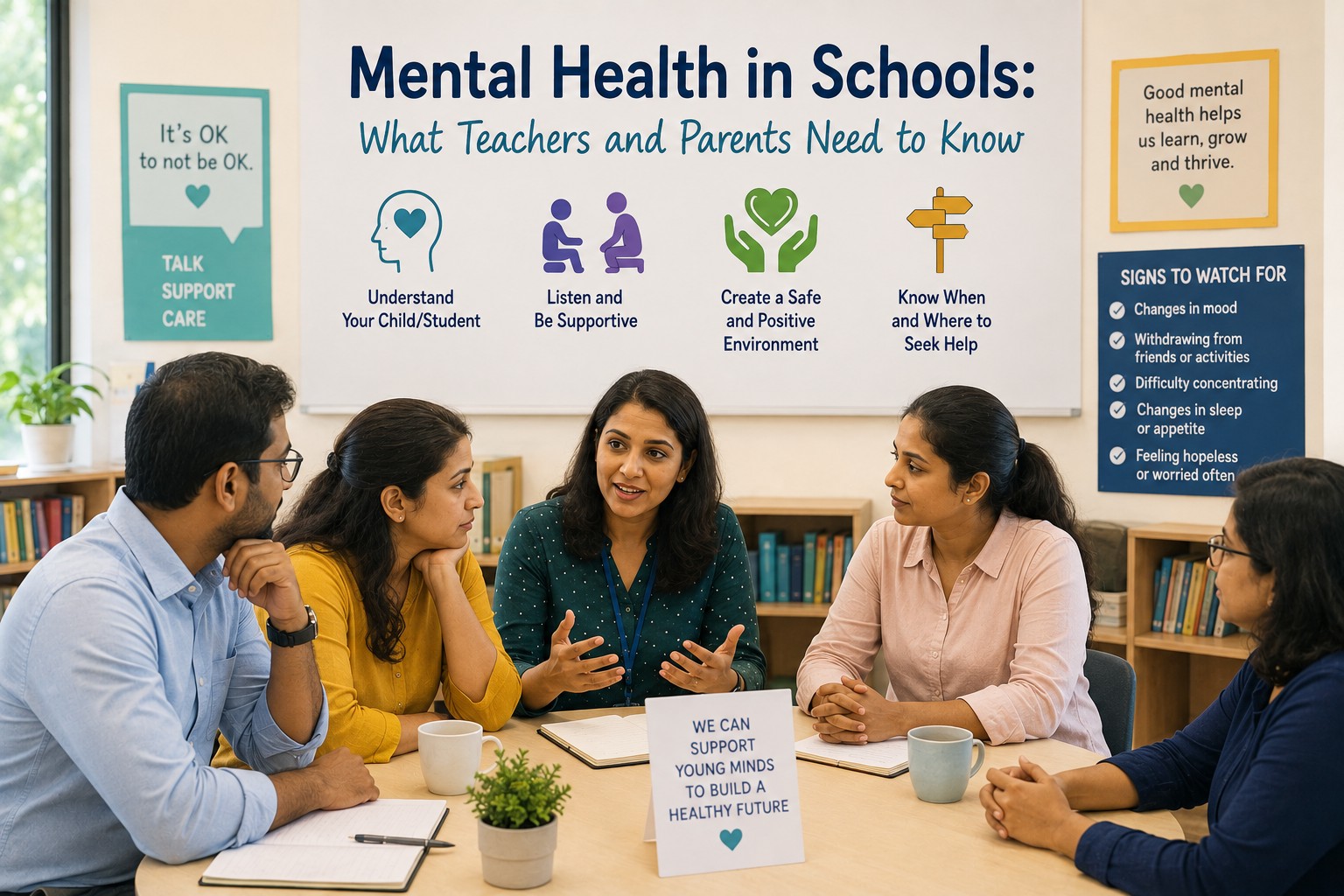
It's worth being precise about something here: teachers are not, and shouldn't be expected to be, mental health professionals. Recognizing the signs of poor mental health in students and creating a classroom where students feel safe enough to say something is well within a teacher's role. Diagnosing or treating a mental health condition is not, and no school should be asking that of its teaching staff. The goal isn't clinical expertise — it's noticing early and knowing where to point a student or family next.
Why does mental health in schools matter?
Because a student who's struggling emotionally is, almost by definition, a student who can't learn at their full capacity — not because they lack ability, but because a distressed nervous system genuinely has less bandwidth left over for focus, memory, and problem-solving. Academic performance and mental health aren't two separate concerns competing for a school's attention. They're the same concern, viewed from two different angles.
There's also a scale to this worth naming plainly: mental health difficulties among school-aged children — anxiety, depression, and stress-related struggles in particular — have been rising for over a decade, well before recent global events accelerated the trend further. A meaningful share of students in any given classroom are quietly dealing with something, whether or not it's visible. Schools that build mental-health awareness into how they operate, rather than treating it as a rare, exceptional issue, are simply responding to the reality already sitting in front of them.
How does school-based mental health support actually work?
Most well-run approaches operate on layers, similar to how schools structure academic support:
Prevention and awareness — the foundational layer everyone gets: a classroom culture where feelings can be discussed without stigma, staff trained to recognize common warning signs, and routine opportunities (a check-in, a quiet one-on-one) for students to raise concerns before they escalate.
Early support — for students showing early signs of struggle: a teacher who's noticed a change flags it to a counsellor, a brief check-in becomes a more regular one, small accommodations get made (extra time, a quieter space, a lighter homework load for a stretch) while the underlying issue is addressed.
Professional intervention — for students whose needs go beyond what a school can reasonably provide on its own: referral to a counsellor, psychologist, or external mental health service, ideally with the school staying looped in and supportive rather than stepping back entirely.
The layer schools most often underinvest in is the first one — awareness and prevention — because it's the least visible and hardest to measure. But it's also the layer that catches the most students earliest, before a quiet struggle becomes a crisis that requires far more intensive (and far more costly) intervention.
What does research say about mental health in schools?
The data on prevalence is sobering but useful to know plainly: children with social, emotional, and behavioural difficulties make up roughly one in five school-aged students globally — meaning in an average classroom, several students are likely dealing with something significant at any given time, even if it isn't outwardly obvious.
Research on early identification is consistent: catching difficulties earlier, at the school level, meaningfully improves outcomes both inside and outside school compared to identification that happens later, often only after a crisis point. Schools sit in a uniquely useful position here — students spend more waking hours at school than almost anywhere else, which makes teachers, more than almost any other adult in a child's life, positioned to notice a change early.
At the same time, research on teachers' own experience with this is candid about the barriers: many teachers report genuine uncertainty about how to raise a concern, worry about overstepping their role, or simply lack training in what to look for. This isn't a knock against teachers — it's a strong argument for why schools need to build structured support and training into the system, rather than leaving it to individual teacher intuition and courage.
Common mistakes schools and adults make with student mental health
Waiting for a dramatic sign before acting. Most mental health struggles in students look quiet — withdrawal, a drop in usual engagement, more absences — not a visible outburst. Waiting for something dramatic before checking in means missing the earliest, easiest-to-help window.
Treating it as purely the counsellor's job. A school with one overworked counsellor and no broader culture of awareness among teaching staff will always be reactive, catching students only after things have escalated far enough to require formal referral.
Assuming a "quiet" or "well-behaved" student is automatically fine. Struggling students who are anxious or withdrawn are often the least disruptive in a classroom, which paradoxically makes them the easiest to overlook — disruptive behaviour gets noticed; quiet struggling often doesn't.
Jumping to diagnosis or labels. A teacher noticing a change in a student is valuable. A teacher speculating about a specific diagnosis, in front of the student or to other staff, is outside their role and can do real harm — the goal is noticing and referring, not naming a condition.
Leaving parents out of the loop too late. Some schools wait until a concern is serious before contacting a family, when an earlier, lower-stakes conversation ("I've noticed X, has anything changed at home?") often surfaces useful context and opens a collaborative relationship instead of an alarming one.
No consistent way to escalate a concern. In many schools, what happens when a teacher notices something depends entirely on which teacher it is and how confident they feel — rather than a clear, known process everyone can follow.
Expert recommendations for supporting mental health in schools
- Train all staff, not just counsellors, to recognize early warning signs — changes in attendance, engagement, sleep-related tiredness, sudden shifts in friendship groups, or a drop in usual performance.
- Build in low-stakes, regular check-ins, so raising a concern doesn't have to wait for a crisis-level moment — a simple one-word feelings check at the start of class normalizes the conversation long before it's urgent.
- Create a clear, known referral pathway, so every teacher knows exactly what to do the moment they notice something, rather than guessing or hesitating.
- Separate noticing from diagnosing, explicitly, in staff training. Teachers should feel confident saying "I've noticed a change" without needing to identify what's causing it.
- Involve parents early and collaboratively, rather than only when a situation has become serious enough to require a formal meeting.
- Model help-seeking as normal, not exceptional, in how staff talk about their own stress and self-care — students take real cues from what adults around them treat as okay to talk about.
Real-world examples of mental health support in schools
The homeroom check-in. A secondary school introduced a two-minute check-in at the start of homeroom, where students could silently rate their day on a simple scale rather than needing to speak up in front of the class. Teachers reported it surfaced concerns — a student consistently marking low for several days running — well before those students would otherwise have said anything out loud.
The staff training shift. One primary school ran a single afternoon of training for all teaching staff, not just the counsellor, on recognizing early signs of anxiety and low mood in children. Within the term, the number of early, low-stakes referrals to the counsellor rose noticeably — not because more students were struggling, but because more staff felt confident enough to notice and act sooner.
The parent-partnership letter. A school began sending a short, plainly worded note home whenever a teacher noticed even a small, early change in a student — framed as "just checking in" rather than a formal concern. Several parents responded with context the school hadn't had (a recent family change, a sleep issue) that helped teachers understand and support the student far earlier than a wait-and-see approach would have allowed.
What should you do next?
If you're a teacher: Start noticing patterns, not single days — one off day is normal; a consistent shift in attendance, engagement, or energy over two or three weeks is worth a quiet, private check-in. You don't need the right words, just genuine ones: "I've noticed you seem a bit different lately — is everything okay?" is enough to open a door.
If you're a parent: Ask more specific questions than "how was school" — try "was there a moment today that felt hard?" — and treat any answer, big or small, as worth taking seriously rather than immediately reassuring away. If a teacher raises a concern, treat it as useful information from someone who sees your child in a different context, not as criticism.
If you're a school leader: Audit whether your current mental-health support relies on one person (usually an overloaded counsellor) or is genuinely distributed across staff through training and a clear process. The schools that catch difficulties earliest are rarely the ones with the most resources — they're the ones where every adult in the building knows what to look for and what to do next.
Mental health in schools isn't a separate department or a once-a-year assembly. It's the quiet, ongoing attentiveness that determines whether a struggling student gets noticed in week two or week twenty — and that difference matters more than almost anything else a school does.
That's the same belief behind everything we build at Happy Sprout: emotional wellbeing isn't a side conversation to academic success. It's the foundation everything else is built on.
Future Starts Within.