
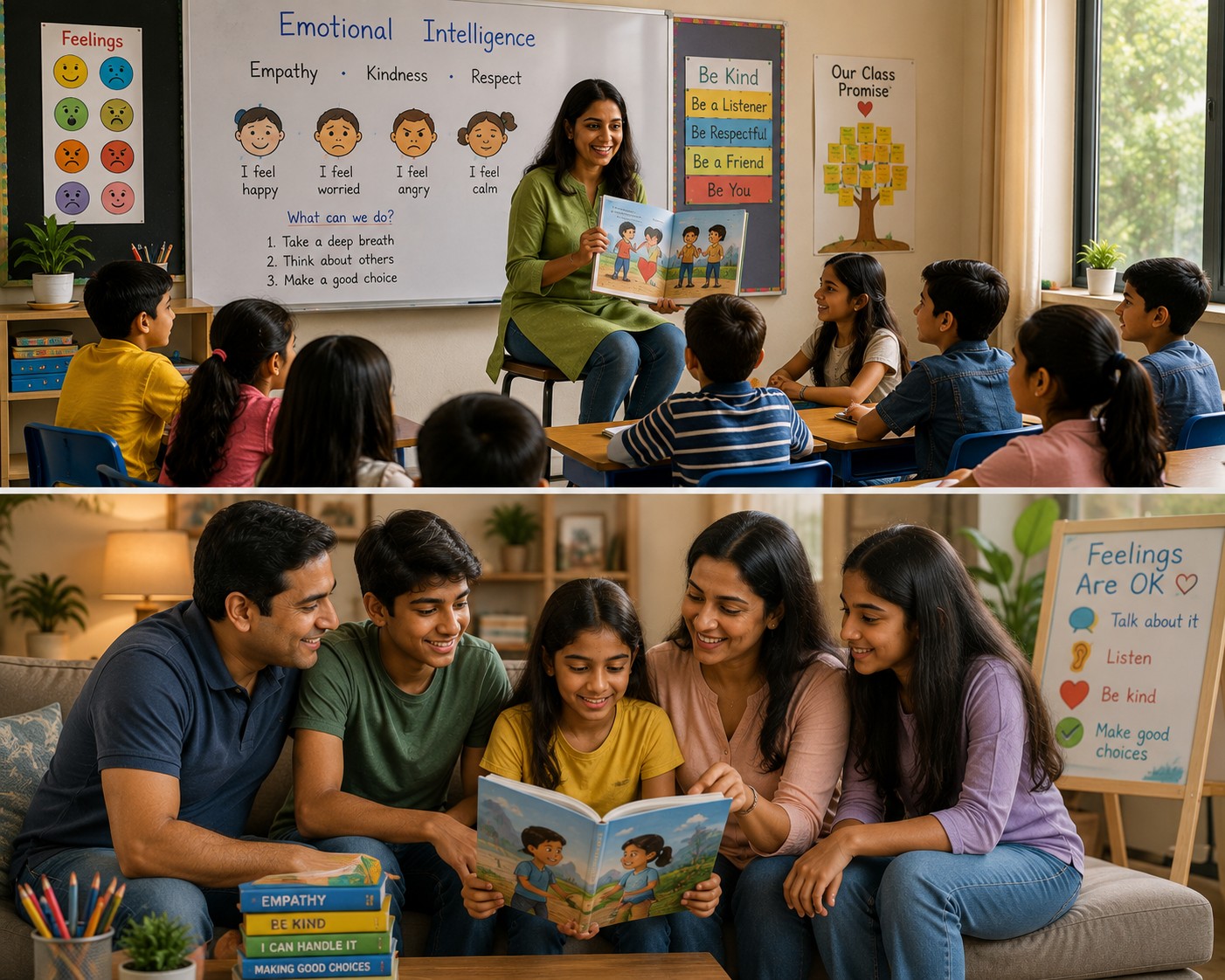
Here's why a story can teach a child something a direct conversation often can't: a story creates distance. A child who won't talk about their own fear will happily discuss why a character in a book was scared. That distance isn't avoidance — it's exactly what makes the lesson land, because the child isn't defending themselves. They're just thinking about someone else's problem, which happens to look a lot like their own.
Here's how to actually use that mechanism on purpose, not just hope it happens by accident during story time.
Why Distance Makes a Story More Useful Than a Direct Conversation
Child therapists have long used a specific technique built around this exact insight, sometimes called "the character has your problem." Rather than asking a child to discuss their own difficult experience directly — a bullying incident, a fear, a family change — the conversation happens through a fictional character facing something similar. The child gets to process the emotional content at a comfortable remove, offering opinions about the character's feelings and choices without ever having to say "this is actually about me."
This isn't a workaround or a trick — it's a legitimate, established therapeutic and educational technique. It works because emotional insight and emotional exposure are two different things, and a story lets a child access the first without forcing the second.
What the Research Actually Says (And Where It's Genuinely Mixed)
A well-known 2013 study by Kidd and Castano proposed that reading a single passage of literary fiction could immediately boost performance on a test of "theory of mind" — the ability to infer what someone else is thinking or feeling. It got enormous attention. It's worth being honest, though: subsequent replication attempts have produced genuinely mixed results — some studies replicated the effect, others found no significant advantage at all. The honest state of the evidence is that a single short passage probably isn't a reliable, instant empathy booster on its own.
What holds up more consistently is a broader, less flashy finding: narrative transportation — the experience of becoming genuinely absorbed in a story's world — is well-documented to increase engagement with a character's emotional experience while the immersion lasts, and regular, sustained engagement with stories over time is associated with stronger social-cognitive skills in children. The honest version of the claim isn't "one bedtime story rewires empathy." It's "consistent, engaged storytelling, discussed well, is a genuinely useful long-term tool" — which is a less dramatic claim, but a more defensible one.
Technique 1: Pause-and-Predict
While reading any story together, pause at an emotionally significant moment and ask: "How do you think they're feeling right now? What do you think they'll do next?" This does two things at once: it builds the habit of actively inferring emotion rather than passively consuming plot, and it gives you a direct window into how your child currently reads emotional situations — which is often more revealing than it looks.
Technique 2: The Character Interview
After finishing a story, "interview" a character together: "If I could ask [character] one question about how they felt, what would it be?" Let your child answer as if they were the character. This technique works particularly well for reluctant talkers — a child who won't answer questions about their own feelings will often answer enthusiastically in character, because the emotional content is technically someone else's.
Technique 3: The Alternate Ending
Ask your child to imagine a different choice a character could have made at a key moment, and what might have happened as a result. "What if she had told a teacher instead of staying quiet — how might that have gone differently?" This builds consequential thinking and decision-making skill through a completely safe, hypothetical lens, with zero real-world stakes attached.
Technique 4: Mutual Storytelling
Child psychiatrist Richard Gardner developed a technique, still used in child therapy today, sometimes called mutual storytelling: a child tells a story of their own choosing, and the adult listens carefully for the emotional themes underneath it — then tells a second story back, using similar characters and setting, but modeling a healthier or more adaptive resolution to the same underlying conflict.
You don't need clinical training to use a simplified version of this at home. If your child spontaneously tells a story where a character is left out or treated unfairly, you can gently offer a version back: "That reminds me of a story — want to hear what happened when a character in it felt the exact same way?" This lets you meet your child's own emotional material with guidance, rather than starting a lesson from scratch.
Technique 5: The "Write Yourself In" Story
For slightly older children, co-write a short story together where the child is the main character facing a real challenge they're currently navigating — a friendship conflict, an upcoming test, a fear. Writing it as a story, rather than journaling it directly, gives the same useful emotional distance as reading someone else's story, but with the added benefit of your child actively authoring their own resolution.
Age-Specific Application
Ages 4–7: Stick to pause-and-predict during picture books, and keep questions concrete: "How does the bear feel? How can you tell?" Facial expressions and simple emotion words are the right level here.
Ages 8–12: Character interviews and alternate endings work well — kids this age can genuinely engage with "what if" reasoning and hold two different possible outcomes in mind at once.
Ages 13–16: Mutual storytelling and "write yourself in" techniques land better with teens, who often respond more openly to a story they're helping shape than to a direct question about their feelings.
What to Do This Week
- Pick one book you're already reading together and add pause-and-predict questions at two or three emotional moments — no need for a new book or a special activity.
- Try the character interview after your next shared story, and notice whether your child opens up more freely "in character" than they do when asked directly about their own feelings.
- If your child tells you a spontaneous story with an emotional undertone, try offering a gentle story back rather than jumping straight to advice — notice how differently that lands compared to a direct conversation.
Storytelling was never just entertainment squeezed in before bedtime. Used deliberately, it's one of the more genuinely useful tools available for building emotional intelligence — not because a single story works magic, but because story after story, discussed well, quietly builds a habit of thinking about feelings that a hundred direct conversations never quite manage to.
Happy Sprout Action: Want your child building emotional intelligence through exactly this kind of guided storytelling and discussion, led by a trained facilitator? Register your child for a live Happy Sprout SEL class at happysproutminds.com — our curriculum uses original stories woven into every lesson across Grades 1–10.
Future Starts Within.