In the mid-1990s, Australian researcher Anthony Jorm ran a national survey asking adults to identify what was going on in short descriptions of people experiencing depression or schizophrenia. The results were striking: only a fraction correctly recognized the conditions being described, and many believed unproven remedies — vitamins, special diets — were more helpful than actual evidence-based treatment. Jorm coined a term for the missing piece: mental health literacy — the knowledge and beliefs that let a person recognize, understand, and appropriately respond to mental health concerns, in themselves or in others.
Here's the part worth taking seriously for parents: that literacy, or the lack of it, starts forming far earlier than most people assume — including the stigma that comes bundled with poor literacy. Waiting until adolescence, or a crisis, to have this conversation means a child has often already absorbed years of unexamined stigma from the culture around them.
Where Stigma Actually Comes From
Children don't invent stigma about mental health independently — they absorb it, the same way they absorb any other cultural attitude, from language used casually around them: "he's crazy," "don't be so psycho," "she's being so bipolar about this." None of these phrases are usually meant as genuine cruelty. They're absorbed casually, repeated casually, and by the time a child needs accurate, compassionate language for a real mental health concern — their own or someone else's — the casual version is often what's already installed.
Research on stigma reduction consistently points to one of the most effective countermeasures: contact-based education — genuine exposure to accurate information and, where possible, real stories from people who've navigated mental health challenges, rather than abstract warnings or, worse, no conversation at all. Silence doesn't prevent a child from forming beliefs about mental health. It just means those beliefs get formed by whatever casual, often inaccurate messaging happens to reach them first.
What Mental Health Literacy Actually Includes for a Child
Following Jorm's broader framework, useful mental health literacy for a child isn't a single conversation — it's a small set of building blocks:
Recognizing that mental health is a normal, universal part of being human — everyone has mental health, the same way everyone has physical health, and it can be doing better or worse at different times, without that being shameful or unusual.
Basic accurate vocabulary, age-appropriate and non-alarming: the difference between having a hard day and experiencing something like depression or anxiety that lasts and genuinely interferes with daily life.
Knowing that help exists and is a normal thing to use — that therapists, counsellors, and doctors who help with mental health are a normal part of healthcare, not a last resort reserved for crisis.
A working sense of who to tell if they, or a friend, are struggling — a trusted adult, made explicit and named, not left as a vague "someone will notice."
Language That Reduces Stigma vs. Language That Reinforces It
Avoid casual clinical language as insult. "That's so OCD of you" or "you're being so bipolar" — even said lightly, without any intended cruelty — teaches a child that real conditions are punchlines, which makes it considerably harder for that same child to take their own or a friend's genuine struggle seriously later.
Use person-first framing where it matters. "A person experiencing depression" rather than "a depressed person" is a small shift that reinforces an important distinction: a mental health condition is something a person has, not the entirety of who they are.
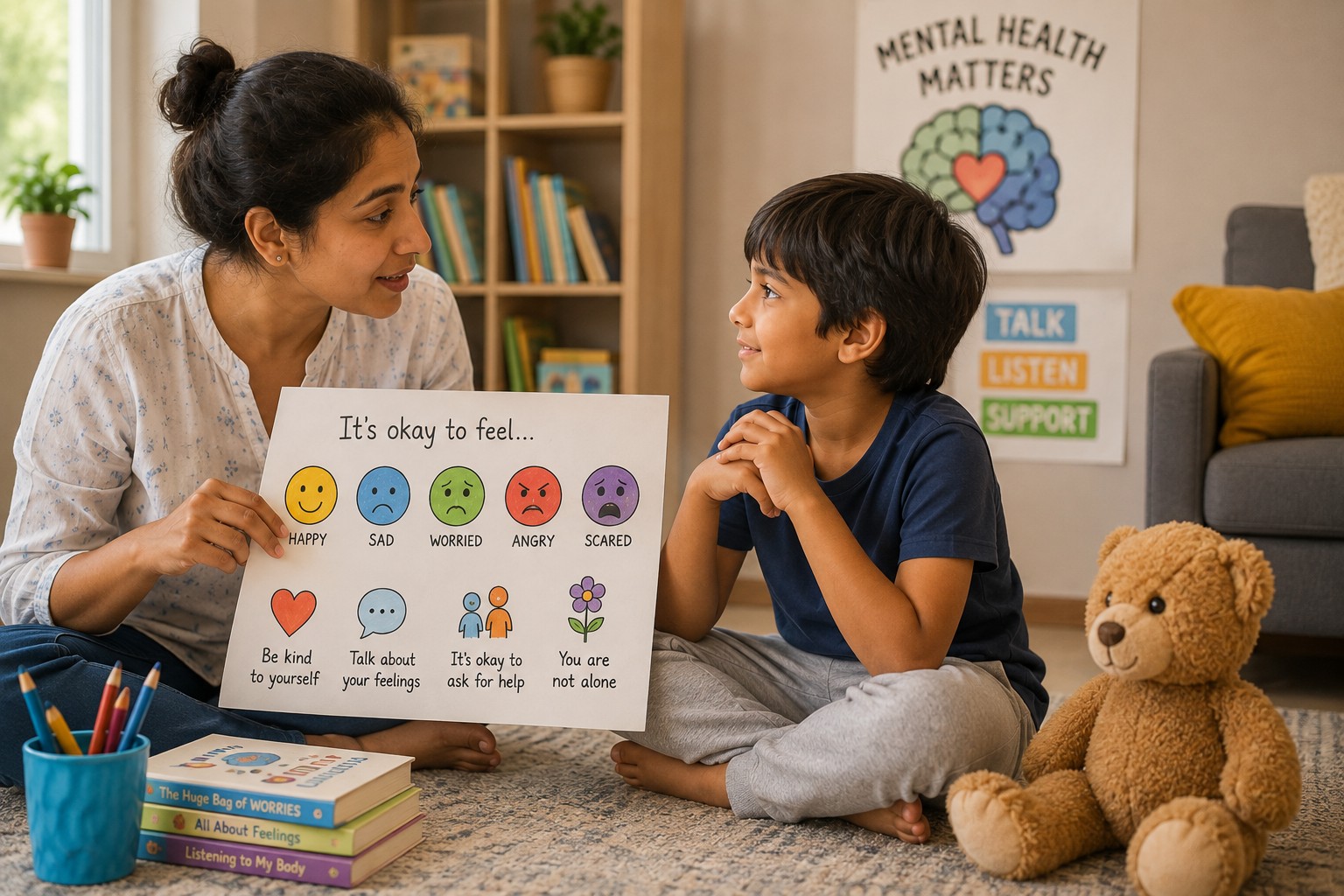
Normalize the vocabulary of help-seeking the same way you'd normalize going to a doctor for a physical illness. "Some people go to therapists to help with big feelings, the same way we go to a doctor when our body doesn't feel right" gives a child an accurate, non-alarming mental model well before they might ever need to use it themselves.
Correct stigmatizing language gently but consistently, including from other kids or media. A brief, calm "that's not really what that word means, and it's not something to joke about" — repeated over time — does real cumulative work, even though any single correction feels small.
Age-Appropriate Ways to Introduce These Concepts
Ages 5–8: Keep it simple and physical — "our brains can feel sick sometimes too, just like our bodies, and there are people whose job is to help with that."
Ages 9–12: Introduce basic accurate vocabulary for common conditions, in plain language, ideally before a child encounters the terms elsewhere in a less accurate or more stigmatizing form.
Ages 13–16: Have direct, honest conversations about mental health as a normal part of the human experience, including real conversations about therapy and help-seeking as an expected, unremarkable option — not something reserved for only the most severe situations.
If you're navigating a specific mental health concern with your own child, please involve a qualified mental health professional — this guide is about general literacy and stigma reduction, not a substitute for clinical assessment or care when it's genuinely needed.
What to Do This Week
- Notice and gently correct one piece of casual stigmatizing language this week — your own, or one you hear repeated by your child — without turning it into a lecture, just a brief, calm correction.
- Introduce one piece of accurate, age-appropriate mental health vocabulary in an ordinary, low-stakes conversation, not tied to a crisis or a worry.
- Normalize the idea of professional help explicitly, in the same tone you'd use for a doctor or dentist, so the concept is already familiar before your child might ever genuinely need it.
Teaching a child about mental health was never about having one perfect, serious conversation. It's about the accumulated, ordinary vocabulary and attitude a child absorbs long before they ever need to use it — built the same patient way any literacy is built, one small, honest conversation at a time.
Happy Sprout Action: Want your child building genuine emotional literacy and a healthy, stigma-free relationship with their own feelings from an early age? Register your child for a live Happy Sprout SEL class at happysproutminds.com, guided by a trained facilitator.
Future Starts Within.