
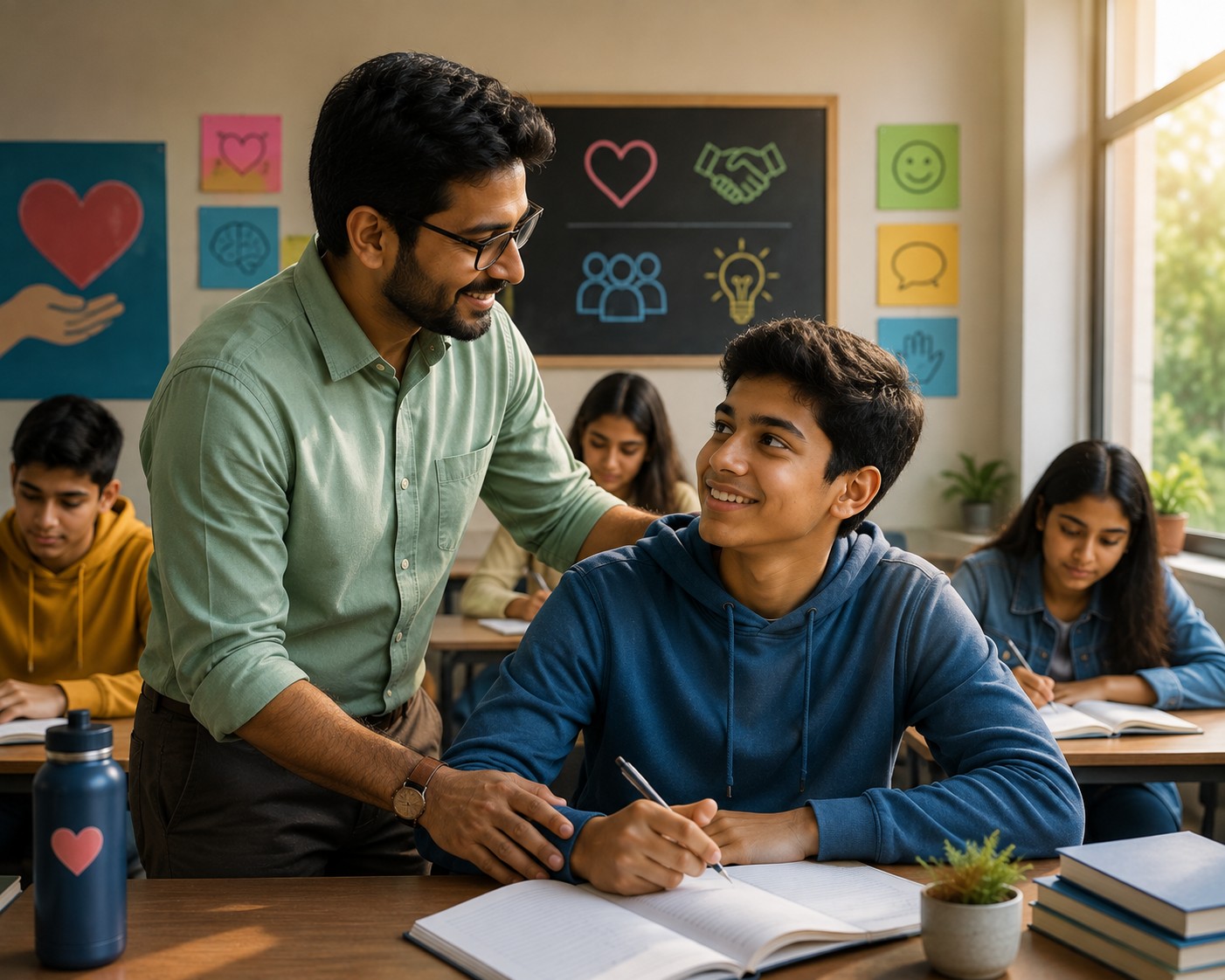
Here's a distinction most classroom management advice never quite makes: a well-behaved classroom and an emotionally safe one are not the same thing. A class can be quiet, compliant, and orderly while every student in it is too afraid of judgment to raise their hand, admit confusion, or say a genuine word about how they're actually doing.
Organizational researcher Amy Edmondson's work on psychological safety — originally studied in hospital teams and workplaces — defined it precisely: the shared belief that it's safe to take an interpersonal risk in a given group. Ask a "dumb" question. Admit you didn't understand. Say you're upset. The concept translates almost perfectly to a classroom, and it explains something a lot of teachers sense intuitively but rarely have language for: the classrooms where learning happens fastest are rarely the strictest ones — they're the safest ones.
Here's the practical handbook for building that, block by block.
Block 1: Structural Safety — Predictability as a Foundation
Emotional safety starts with something almost boringly logistical: a student who knows what to expect feels safer than a student navigating constant uncertainty, even before a single word about feelings is spoken.
- Consistent routines for entering, transitioning, and exiting the room. Predictability itself is calming — a child's nervous system relaxes when the shape of the day is familiar.
- Clear, few, consistently enforced expectations. Three or four rules, applied the same way every time, build more trust than fifteen rules enforced inconsistently.
- Advance notice of changes. A heads-up before a substitute teacher, a schedule change, or an unusual activity reduces the low-grade anxiety that unpredictability creates for many students.
Block 2: Relational Safety — The Teacher-Student Bond
Psychologist Carl Rogers' concept of unconditional positive regard — accepting a person's worth regardless of their behaviour in any given moment — has direct application here. A student needs to trust that a bad day, a wrong answer, or a moment of misbehaviour doesn't change how a teacher fundamentally feels about them as a person.
- Greet every student individually, by name, at the door. This single, low-effort habit consistently shows up in classroom-climate research as disproportionately effective for building relational trust.
- Separate the behaviour from the person, explicitly, in language. "That wasn't okay" lands very differently than "you're being difficult" — even addressing the identical incident.
- Notice students when nothing is wrong, not just when something is. A quick, genuine comment about something unrelated to academics — an interest, a small win — tells a student they're seen as a person, not just managed as a behaviour to control.
Block 3: Mistake Safety — Making Errors Genuinely Low-Stakes
Most students, across every culture and school system, learn early that mistakes are something to hide, not share. Reversing that norm is one of the highest-leverage things a teacher can do for both learning and emotional safety at once.
- Publicly normalize your own mistakes as a teacher. "I got that wrong the first time too — let me show you what I fixed" does more to de-stigmatize error than any classroom poster about growth mindset.
- Respond to wrong answers with genuine curiosity, not correction-first. "Tell me how you got there" before "here's the right answer" keeps a student engaged in the reasoning rather than immediately shutting down in embarrassment.
- Avoid public, comparative correction. Correcting a student's work in front of the class, especially by contrast with a "better" answer, teaches the whole room that mistakes are socially costly — which quietly discourages every student from ever risking one out loud again.
Block 4: Emotional Expression Safety — Big Feelings Without Shame
A classroom is emotionally safe only if a student who's genuinely upset — crying, frustrated, overwhelmed — isn't met with embarrassment, punishment, or being singled out in front of peers.
- Have a quiet, non-punitive way for a student to step back and regulate. A designated calm corner, framed as a tool rather than a consequence, gives a student somewhere to go that isn't "the hallway for being in trouble."
- Respond to visible distress privately, not publicly. A quiet word or gesture rather than a loud, class-wide acknowledgment respects a student's dignity in a hard moment.
- Never use a student's emotional reaction as a teaching example for the class, even with good intentions — it teaches every other student watching that big feelings become public spectacle if they're not careful.
Block 5: Social Safety — Protecting the Room From Each Other
Teacher behaviour builds part of emotional safety. Peer dynamics build the rest, and they need active management, not just hope.
- Actively interrupt exclusion and mockery the moment you see it, even small instances — a consistently enforced zero-tolerance norm for ridicule does more for classroom safety than almost anything else on this list.
- Rotate group work assignments deliberately, rather than always letting students self-select, to prevent the same small cluster of students from being repeatedly excluded.
- Model respectful disagreement yourself in class discussions, so students see what it looks like to hold a different opinion without personal attack.
Block 6: Voice Safety — Equitable Participation
Some students speak up constantly; others never do — and it's rarely about how much they know.
- Use wait time deliberately. A few extra seconds of silence after a question, before calling on anyone, allows slower-to-formulate students to actually participate rather than being consistently beaten to the answer by the fastest hands.
- Offer non-verbal ways to participate, like written responses or thumbs-up/down check-ins, for students who find speaking aloud in front of the class genuinely difficult.
- Never put a struggling student "on the spot" as a teaching moment. Cold-calling a student who's visibly unprepared, in front of peers, teaches the whole room that participation carries real social risk.
What to Do This Week
- Pick one block from this handbook — the one your classroom is weakest on — and focus there first. Trying to overhaul all six at once dilutes the effort; real culture change happens through consistent focus on one or two shifts at a time.
- Start with Block 2 if you're unsure where to begin. The individual door greeting is the single lowest-effort, highest-return habit on this entire list.
- Audit your own response the next time a student gets something wrong or shows a big feeling in class. Notice whether your instinctive reaction builds safety or quietly erodes it — that instinct is usually the most honest diagnostic available.
An emotionally safe classroom was never about being softer or lowering expectations. It's about building the exact conditions under which real learning — the kind that requires risk, error, and honesty — actually becomes possible.
Happy Sprout Action: Want structured support bringing psychological safety and SEL practices into your classroom, backed by trained facilitators? Explore Happy Sprout's school partnership and teacher training programmes at happysproutminds.com — and if you're a parent reading this as well, you can register your own child for a live Happy Sprout SEL class at the same link to build these same skills outside the classroom too.
Future Starts Within.