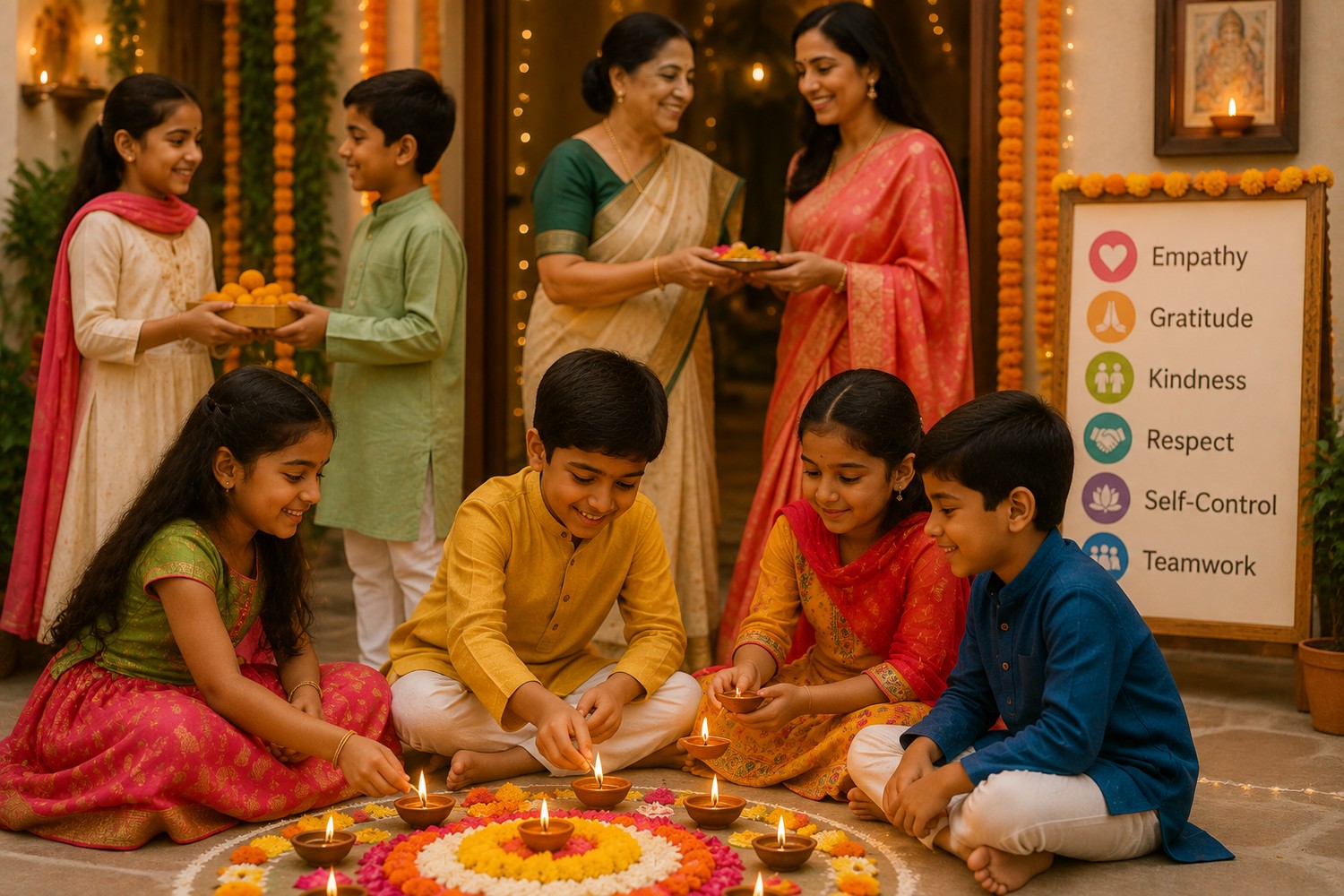
Ask a parent whether their child has had SEL instruction this month, and most would say no — no class, no worksheet, no formal lesson. Ask the same parent whether their family lit diyas together, shared sweets with neighbours, or fasted through Ramadan this month, and the answer is often yes. Those aren't two separate categories of experience. The second one is frequently doing the work of the first — it's just never been named that way.
Indian festivals and family traditions, across the country's many religions and regions, already build every one of CASEL's five core competencies, consistently and repeatedly, often more deeply than a classroom lesson could. Here's the actual mapping — and how naming it explicitly makes the lesson land even more clearly for a child.
Self-Management: Fasting, Discipline, and Delayed Gratification
Ramadan and Eid. The month of fasting that precedes Eid-ul-Fitr is, at its core, a sustained practice in self-regulation and delayed gratification — a daily discipline held for weeks, often by children old enough to participate, culminating in a genuinely earned celebration. This is self-management practised at a scale few classroom exercises could replicate.
Navratri fasting practices. Many families observing Navratri take on some form of dietary discipline across the nine nights — another sustained, repeated practice in managing impulse and staying committed to something difficult over time, not just a single day's effort.
Diwali cleaning rituals. The days of deep-cleaning and organizing the home before Diwali — often genuinely tedious work — build follow-through and delayed gratification: the effort now, for the celebration later, is the whole structure of the tradition.
Social Awareness: Generosity Across Social Lines
Eid charity practices. The tradition of Zakat and Fitrana — obligatory charitable giving tied specifically to Eid — builds a concrete, repeated lesson in social awareness: a portion of what you have is set aside for those with less, as a structural expectation, not an optional afterthought.
Diwali sweet-sharing. Distributing sweets to neighbours regardless of closeness or relationship status quietly teaches that generosity isn't reserved only for people you're already close to — it's a norm extended to a wider community.
Onam Sadya. The traditional Onam feast is historically rooted in an ideal of shared abundance and equality at the table — a lived lesson in communal generosity that a child absorbs simply by participating in the meal, long before they could articulate the concept in words.
Relationship Skills: Rituals Built Entirely Around Connection
Raksha Bandhan. A festival built structurally around naming and reaffirming a sibling bond — tying the thread is almost incidental; the real content is the explicit, repeated act of saying "I see this relationship and I'm choosing to honour it."
Touching the feet of elders. A common practice across many Indian households during festivals and family gatherings, this ritual builds a concrete, embodied habit of respect and connection across generations — a physical, repeated action that reinforces relationship skills more durably than a verbal instruction alone.
Garba and Dandiya during Navratri. Community dance that deliberately mixes age groups and social circles builds real, practised social connection — moving in coordinated rhythm with people outside your immediate family is a genuine relationship-skill exercise, even though it never feels like one.
Responsible Decision-Making: Reflection and Renewal
Holi's Holika Dahan. The bonfire the night before Holi carries a specific symbolic function — the deliberate letting go of old grudges and negativity before the color celebration begins the next day. Framed explicitly to a child, this is a genuine lesson in choosing renewal over holding onto resentment, a real decision-making skill dressed as ritual.
Diwali's Lakshmi Puja and fresh-start framing. The new-year, fresh-start symbolism many families attach to Diwali — new clothes, cleared debts, a reset home — builds the concrete idea that a person can choose to close one chapter deliberately and start the next one differently, rather than simply drifting forward unchanged.
Self-Awareness and Gratitude: Naming What Matters
Guru Purnima. A festival built specifically around honouring teachers and mentors — an explicit, structured occasion for a child to identify and articulate who has shaped them, which is precisely the kind of specific, person-directed gratitude research has found most protective for wellbeing.
Pongal and harvest festivals. Festivals centered on gratitude for the harvest — Pongal, Sankranti, Bihu — build a direct, repeated practice of expressing thanks for something beyond oneself, at a scale and consistency few standalone gratitude exercises could match.
Why Naming the Lesson Explicitly Still Matters
Here's the honest caveat: a child absorbing these lessons implicitly, through repeated participation, doesn't necessarily connect them consciously to a transferable skill. A child who's fasted through Ramadan for years has genuinely practised self-regulation — but may never have made the connection to, say, resisting the urge to interrupt in a group project at school.
This is where naming the skill explicitly adds real value on top of the tradition itself. After Raksha Bandhan: "That's you actively choosing to strengthen a relationship — that's a real skill, and you can use it with friends too." After Holika Dahan: "Letting go of a grudge on purpose, like tonight's ritual, is something you can choose to do with a friend you're upset with, too." The tradition does the practice. The naming makes the practice transferable.
What to Do This Week
- Pick the next festival or family tradition on your calendar, and identify which CASEL competency it most directly builds using the map above.
- Name the skill explicitly to your child once, in simple language, right after the tradition — not as a lecture, just a brief, genuine connection: "did you notice what that ritual was actually teaching you?"
- Look for the same skill showing up outside the festival context in the weeks that follow, and point it out when it does — "that's the same thing you practised during..."
Indian families were never short on tools for building emotional intelligence — the traditions have been doing this work for generations. The only missing step, most of the time, is simply saying it out loud.
Happy Sprout Action: Want your child building these same skills with structured, guided reinforcement that connects to the traditions your family already practises? Register your child for a live Happy Sprout SEL class at happysproutminds.com — our India-first curriculum is built to resonate with the cultural context your child actually lives in.
Future Starts Within.