
Skeptical parents and school principals tend to ask the exact same question: "Doesn't SEL just take time away from studies?"
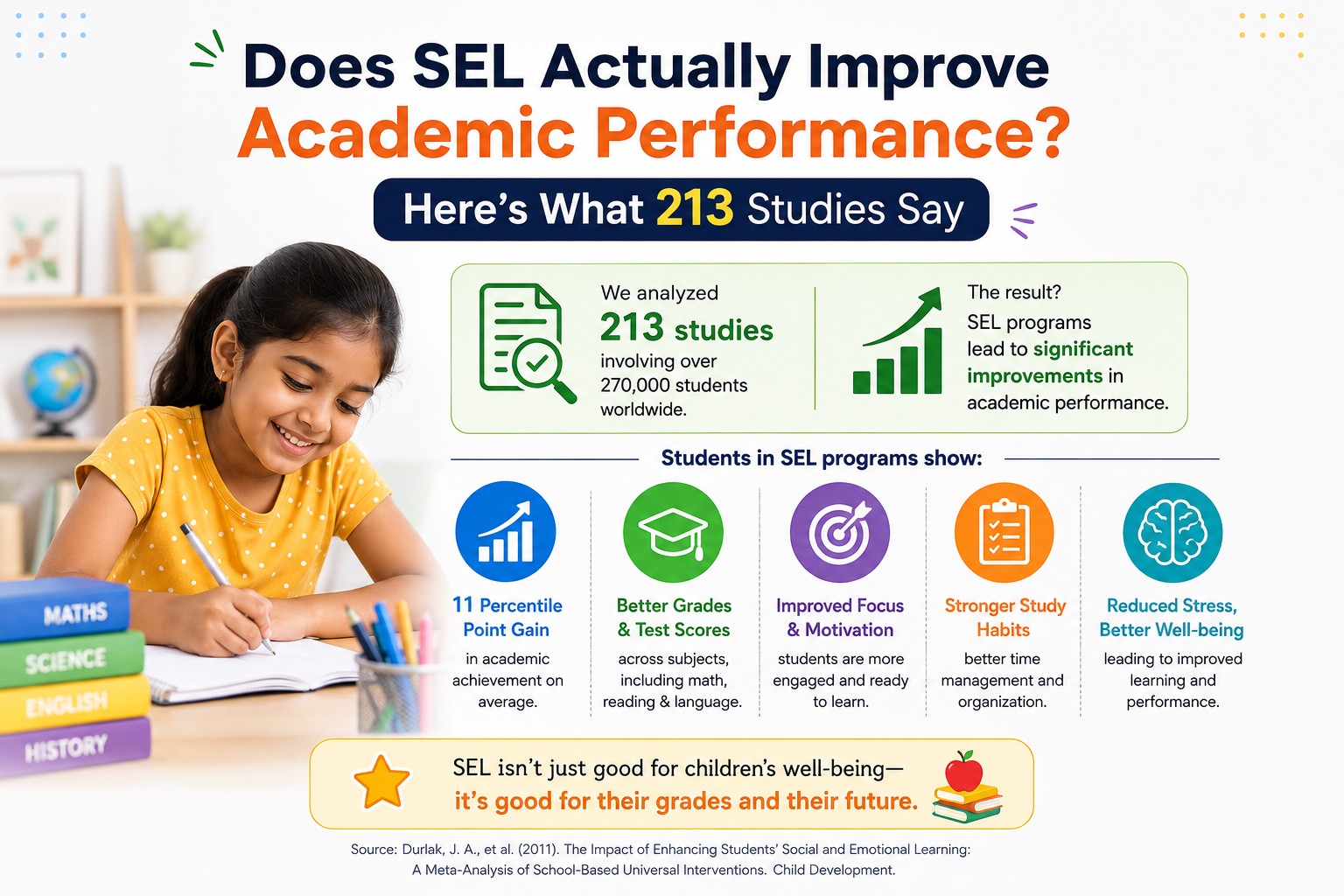
The research doesn't just say no. It says the opposite. Students in quality SEL programmes have outperformed control groups by an average of 11 percentile points in academic achievement. Here's the evidence — stripped of jargon, and made actionable.
The Durlak Meta-Analysis: What 213 Studies Actually Found
In 2011, Joseph Durlak and colleagues published a landmark meta-analysis in the journal Child Development, pooling data from 213 school-based SEL programmes involving 270,034 students, from kindergarten through high school. It remains, over a decade later, the most cited justification for SEL in the research literature.
The findings, compared to control groups who received no SEL programming:
- Academic achievement improved by 11 percentile points, on average
- Social and emotional skills improved significantly
- Conduct problems — disruptive behaviour, aggression, bullying, discipline referrals — dropped meaningfully
- Emotional distress — anxiety, depression, social withdrawal — reduced meaningfully
- Positive social behaviour increased significantly
Here's the finding worth sitting with the longest: academic performance didn't just hold steady while SEL was being taught — it went up. SEL wasn't competing with academics for classroom time. It was quietly making the academic time that remained more effective.
A follow-up meta-analysis in 2017 (Taylor, Oberle, Durlak, and Weissberg), covering 82 additional SEL programmes and nearly 100,000 students, tracked outcomes anywhere from 6 months to 18 years after the programme ended. The benefits weren't a short-term sugar high — they were still measurable well beyond the programme itself, even if, as with most educational interventions, the effect naturally softened somewhat compared to the immediate post-programme boost. SEL isn't a quick fix. It builds something that lasts.
How Emotional Regulation Directly Affects Memory and Focus
The link between emotional regulation and academic performance isn't just a correlation researchers noticed and can't explain. It's neurological.
Here's the mechanism: when a child is dysregulated — anxious, angry, shut down — the brain's stress hormone cortisol floods the hippocampus, the region responsible for forming new memories. In that state, learning isn't just harder. It's genuinely impaired at the biological level.
Flip it around: when a child feels emotionally safe and regulated, the prefrontal cortex — the part of the brain responsible for attention, working memory, and complex thinking — has the resources to actually operate at full capacity.
A calm child is a learning child. That's not a motivational poster. That's neuroscience.
The Economic Case: $11 Back for Every $1 Invested
If the academic and neurological case hasn't convinced a skeptical principal, try the spreadsheet.
A 2015 economic analysis by Clive Belfield and colleagues at Columbia University's Teachers College — often cited via its home institution, the Center for Benefit-Cost Studies in Education — assessed six well-established SEL programmes and found an average benefit-cost ratio of roughly 11 to 1. In plain terms: every ₹1 (or $1) invested in a well-implemented SEL programme returned roughly ₹11 (or $11) in value — through reduced special education needs, lower rates of problem behaviour, better long-term health outcomes, and higher lifetime earnings for participating students.
This is one of the most frequently cited figures in global education policy discussions on SEL, precisely because it reframes the conversation. SEL isn't a cost centre competing with the academic budget. It's one of the highest-return investments a school can make, on the same spreadsheet principals already use to justify everything else.
What This Means for Indian Schools and Parents
India's National Education Policy 2020 names holistic development as a core mandate, not a supplementary goal. Given the evidence above, that's not a soft aspiration — it's backed by a genuinely robust research base spanning multiple independent meta-analyses, tens of thousands of students, and over a decade of follow-up data.
Which means the framing most schools still use — "we'll consider SEL once the syllabus is covered" — has the priority backwards. Every year a child spends in a purely academic environment, without structured SEL development, is a year of compounding emotional-skill deficit that the research suggests is actively working against the academic outcomes that environment is trying to protect.
The Bottom Line
Here's the honest summary, stripped of the jargon one more time:
- 213 studies, 270,034 students: SEL improves academic performance, it doesn't cost it.
- The benefits hold up for years after the programme ends — this isn't a short-term intervention, it's a lasting skill.
- The regulation-to-learning link is neurological, not theoretical — a dysregulated brain genuinely cannot learn as effectively.
- The economic case is one of the strongest in education policy — an 11-to-1 return is difficult for any school budget conversation to ignore.
If you're a parent, this is the evidence to bring to your next PTA meeting. If you're a principal, this is the evidence that turns "should we prioritize SEL" into “can we afford not to.”
Future Starts Within.