
Most parents notice the moment their child falls behind in maths or reading. Report cards make sure of that.
Emotional intelligence gaps are different. They go undetected for years — quietly limiting friendships, eroding confidence, and setting the stage for struggles well into adulthood. No report card flags this one.
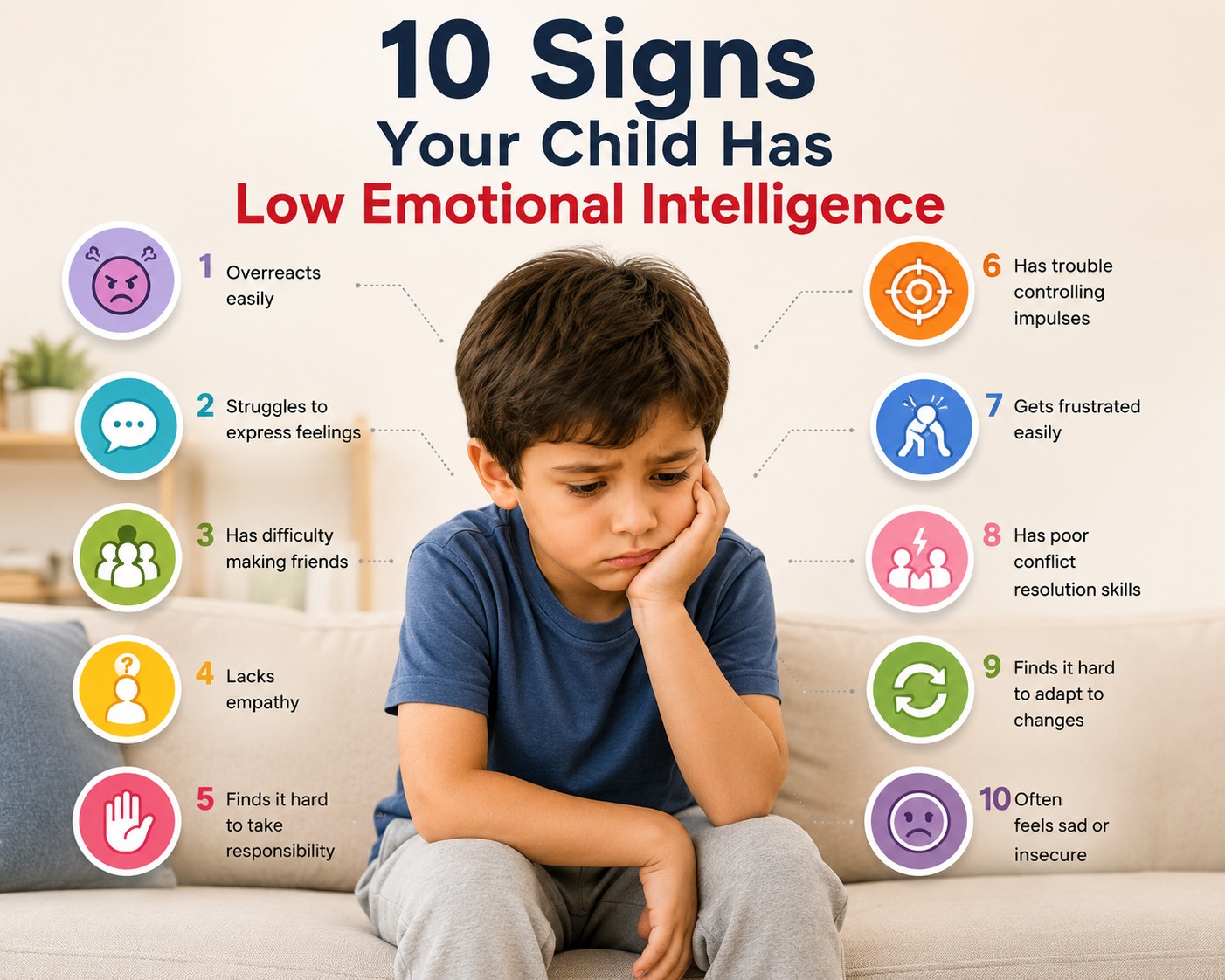
Here are 10 specific signs to watch for, and an evidence-based step for each. One note before you read further: none of these are character flaws. Every single one is a skill gap — and skills, unlike traits, can be taught.
Sign 1: Always Blames Others for Problems
"It's not my fault." If you've heard this phrase more times than you can count, take note — it's one of the clearest markers of low self-awareness in a child.
Here's what's actually happening: when something goes wrong, a child with underdeveloped self-reflection looks outward for a cause, automatically. This isn't defiance. It's a skill they've simply never been taught — the ability to look inward first.
What to do: After a conflict or failure, ask — gently, without judgment — "What's one small thing that was in your control in this situation?" Not "what did you do wrong" — that question triggers defensiveness before any reflection can happen. "One small thing" opens the door instead of slamming it.
Sign 2: Cannot Identify What They're Feeling
Ask a child with low EQ how they're feeling, and you'll get one of three answers: "fine," "okay," or "I don't know." Not because they're being difficult — because those are, quite literally, the only emotion words available to them.
Psychologist Dr. Lisa Feldman Barrett's research on emotional granularity shows something worth internalizing here: a limited emotional vocabulary directly limits a person's ability to regulate what they feel. You genuinely cannot manage what you cannot name.
What to do: Print an emotion wheel — look for one with 100+ words — and put it somewhere visible, like the fridge. Make naming emotions a daily game, not an interrogation: "pick a word off the wheel for how today felt" works far better than "how are you feeling."
Sign 3: Struggles to Make or Keep Friends
Friendships run on a specific skill set: empathy, taking turns in conversation, repairing after conflict, reading social cues. A child with low social awareness tends to land on one of two extremes — dominating every interaction, or withdrawing from them almost entirely. Both patterns point to the same underlying gap, just expressed in opposite directions.
What to do: Role-play tricky social scenarios at home before they happen at school — "what would you say if a friend didn't want to play the game you picked?" Rehearsal in a low-stakes setting builds the exact skill that's missing, without the social cost of getting it wrong in real time.
Sign 4: Overreacts to Small Problems
A twenty-minute meltdown over a broken pencil is, on the surface, wildly disproportionate to the actual event. But here's the reframe worth making: that disproportion is the diagnosis, not a discipline problem. The child hasn't yet developed the ability to calibrate an emotional response to how serious a situation actually is.
What to do: In a calm moment (never mid-meltdown), introduce a simple 1-to-10 "problem size" scale — a broken pencil is maybe a 2, a real emergency is a 10. Practising the scale when nothing's wrong builds the calibration skill your child can then reach for when something is.
Sign 5: Cannot Handle Losing or Failure
A child who falls apart after losing a board game or getting a disappointing mark often has a self-concept that's become entirely tied to performance. This is a self-awareness and resilience gap — and it's worth naming plainly: India's intensely mark-focused education culture is fertile ground for exactly this pattern to take root.
What to do: After a loss, separate the outcome from the identity, out loud: "You lost the game. That doesn't mean you're bad at it — what's one thing you'd try differently next time?" Repeated often enough, this becomes the child's own internal script.
Signs 6–10 At a Glance
Sign 6: Struggles to wait their turn or control impulses in group settings. What to do: Practice "wait" games at home — Simon Says, freeze dance, anything requiring a pause before acting — to build impulse control in a low-stakes, playful context.
Sign 7: Rarely shows empathy when others are upset — seems indifferent or confused. What to do: Narrate others' emotions out loud in everyday moments — "that boy looks really disappointed his team lost" — to build the habit of noticing before expecting a child to respond to it.
Sign 8: Often says "I hate you" or reaches for extreme language during conflict. What to do: Stay calm and reflect the underlying feeling rather than the words: "You're really angry with me right now" — extreme language is usually a vocabulary gap, not a true statement of feeling.
Sign 9: Cannot self-soothe — always needs a parent to regulate them. What to do: Build a simple calm-down toolkit together (see our guide on child emotional meltdowns) and practise using it during calm moments so it's already familiar by the time it's actually needed.
Sign 10: Finds it difficult to apologise genuinely without being forced. What to do: Model real apologies yourself, including the "what I'll do differently" part — a forced "sorry" teaches compliance, not the actual skill of repair.
The Good News: Every One of These Is a Teachable Skill
Here's the part worth reading twice if you recognized your child in more than one of these: not one of these ten signs is a fixed trait. Every single one reflects an underdeveloped skill — and skills, unlike personality, respond to practice.
Research on targeted SEL interventions consistently shows measurable improvement in these exact markers within weeks of consistent practice, not years. This isn't about waiting for your child to "grow out of it." It's about giving them the specific, teachable tool they're currently missing.
Future Starts Within.