
A father once told me his six-year-old had started narrating his own meltdowns. Mid-tantrum, red-faced, fists clenched, the boy would stop and announce: "I am having a VERY big feeling right now." Then he'd go right back to being upset.
It sounds almost comic, but it's actually a small miracle. He hadn't learned to stop the feeling — nobody does that at six, or honestly at thirty-six. What he'd learned was to notice it, in real time, which is the actual first skill of emotional intelligence. Everything else — calming down, making a better choice, understanding someone else's big feeling — builds on that one habit.
The good news is that this particular habit doesn't need a therapist's office or a special program to build. It needs repetition, and repetition needs games. That's what emotional intelligence activities for kids actually are — not lessons in disguise, but low-stakes, repeatable practice for a skill that would otherwise only get exercised in the middle of a crisis, which is the worst possible time to learn anything.
What are emotional intelligence activities?
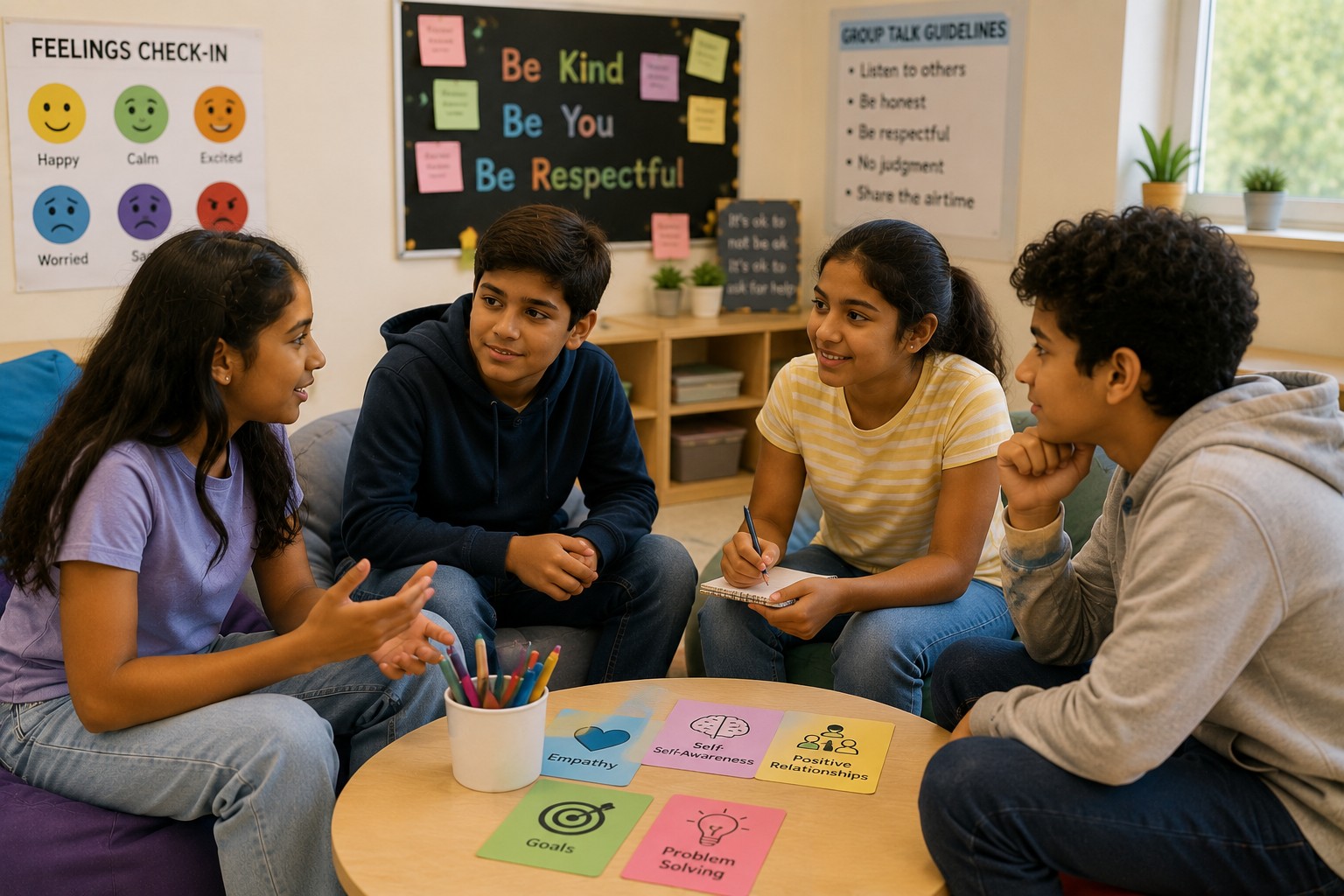
At their core, emotional intelligence activities for kids are simple, structured exercises that give a child practice with one of four things: noticing a feeling, naming it, managing it, or recognizing it in someone else. They don't need to look serious or clinical — in fact, the best ones barely look like "SEL" at all. A round of charades, a five-minute chart on the fridge, a two-minute chat at bedtime — these count just as much as anything with a worksheet attached.
The through-line across all of them is low stakes, high repetition. A single deep conversation about feelings, once a year, does very little. A thirty-second check-in, four times a week, does a lot — because emotional intelligence is built the same way any skill is: small reps, repeated often, until the response becomes automatic instead of effortful.
Why do emotional intelligence activities matter?
Because the alternative is trying to teach this skill in the moment it's needed most — mid-meltdown, mid-argument, mid-crisis — which almost never works. A child (or an adult, for that matter) flooded with a big feeling has very little capacity left to learn anything new. The brain in that state is running on instinct, not lesson plans.
SEL activities for parents and teachers work precisely because they happen at the opposite time — when a child is calm, curious, maybe even having fun. That's when new vocabulary sticks, when new habits actually form. By the time the real meltdown arrives, the skill isn't being taught for the first time. It's just being retrieved.
This is also why activities beat lectures. Nobody, of any age, becomes better at managing frustration by being told to manage their frustration. They become better at it by practicing, in low-pressure settings, until the practiced response is the one that shows up automatically under pressure too.
How do emotional intelligence activities actually work?
Most effective activities quietly target one (or more) of four building blocks:
Vocabulary — activities that build a child's word bank for feelings beyond "good," "bad," "fine." The wider the vocabulary, the more precisely a child can name what's happening, and precision is what makes a feeling manageable instead of overwhelming.
Recognition — activities that train a child to notice emotional cues, in themselves and in others: facial expressions, body language, tone of voice.
Regulation — activities that give a child an actual tool to use once a feeling has been named, so naming it doesn't just become another thing to feel stuck with.
Empathy — activities that build the habit of imagining someone else's experience, not just reacting to your own.
A good activity rarely targets only one. Emotion Charades, for example, works vocabulary and recognition at once. A feelings journal works vocabulary and regulation. The best ones layer two or three together without a child ever noticing they're "doing SEL" — it just feels like a game, or a two-minute habit, or something a bit silly at the dinner table.
What does research say about emotional intelligence activities?
The research on age-appropriate emotional intelligence activities is fairly consistent: structured, repeated practice with feelings vocabulary and self-regulation, delivered through games and routines rather than lectures, produces measurable gains — better peer relationships, fewer behavioural incidents, and stronger academic focus, often within the same school term. Large-scale reviews of Social-Emotional Learning (SEL) programs, which are essentially collections of exactly this kind of activity, consistently find improvements not just in emotional skills but in academic performance too — the two move together, not separately.
There's also a specific finding worth knowing: activities that ask a child to label an emotion — simply putting a word to what they're feeling — have been shown to reduce the intensity of that feeling in the moment. Psychologists sometimes call this "affect labeling." It's a big part of why something as simple as a feelings journal or a daily one-word check-in works better than it has any right to for something so small.
Common mistakes with emotional intelligence activities
Only doing them once, or only during a crisis. An activity done once, right after a meltdown, teaches far less than the same activity done for two minutes, four times a week, when nothing is wrong. Repetition in calm moments is what makes the skill available in hard ones.
Making it feel like a lesson. The moment an activity starts to feel like schoolwork rather than a game, engagement drops — especially with older kids who are quick to disengage from anything that smells like a worksheet.
Choosing activities that are too advanced (or too babyish) for the age group. A feelings-vocabulary game pitched at a six-year-old will bore a twelve-year-old, and a complex reflection journal will frustrate a six-year-old. Matching the activity to the child's actual developmental stage matters more than most people expect.
Skipping the "why." Kids, especially older ones, engage more when they understand the point of an activity, even briefly — "this helps you catch a big feeling before it gets too big" lands better than an unexplained instruction to "draw how you feel."
Doing it to the child instead of with them. Activities led with genuine curiosity — "I wonder what that felt like" — build far more trust and openness than activities that feel like an assessment or a test of whether the child is "doing emotions right."
Expert recommendations for using emotional intelligence activities
Little and often beats big and rare. A two-minute daily habit outperforms a single, longer session once a month.
Model the activity yourself first. Kids engage more when an adult goes first and shows a bit of vulnerability — "I felt really frustrated today when..." — before asking a child to do the same.
Rotate activities so they don't go stale. The same feelings chart every single day loses its power quickly; a small rotating set keeps it fresh and playful.
Use activities proactively, not just reactively. The best time for a feelings check-in is a calm moment, not the five minutes right after a blow-up.
Let younger kids act it out, and let older kids reflect on it. Charades and physical games work brilliantly for younger children; journaling and discussion tend to land better as kids move into upper primary and beyond.
Real-world examples of emotional intelligence activities in action
At home: A mother started a "rose and thorn" ritual at dinner — everyone shares one good moment (the rose) and one hard moment (the thorn) from their day. Her nine-year-old, normally a one-word answer to "how was school," started volunteering things she'd never have mentioned otherwise, simply because the format made space for the hard part too, not just the good news.
In the classroom: A Grade 3 teacher began every Monday with a sixty-second "weather report" — each student says one word for their emotional weather (sunny, stormy, foggy) as they walk in. It costs almost no class time, but it gives the teacher an instant read on who might need a gentler start to the day, and it normalizes talking about feelings as an ordinary part of the morning, not a special occasion.
Between siblings: Two brothers, constantly bickering, started playing an emotion-guessing game their parents introduced almost as a joke — one acts out a feeling silently, the other guesses. Within a few weeks, their parents noticed the boys using the same vocabulary from the game during actual arguments: "I think you're feeling left out, not just angry." The game had quietly built a shared language they hadn't had before.
10 emotional intelligence activities to try this week
1. The Feelings Weather Report. Each morning (at home or in class), everyone shares one word for their emotional "weather" — sunny, cloudy, stormy, foggy. Takes under a minute, builds vocabulary, and normalizes checking in daily.
2. Emotion Charades. Write emotions on slips of paper — frustrated, proud, nervous, relieved — and take turns acting them out silently while others guess. Builds recognition of facial expressions and body language, and it's genuinely fun, not just educational.
3. The Rose, Thorn, and Bud. At dinner or circle time, each person shares a rose (something good), a thorn (something hard), and a bud (something they're looking forward to). Gives equal space to hard feelings and good ones, instead of skipping straight to "fine."
4. The Feelings Thermometer. Draw a simple thermometer on paper with levels from calm to overwhelmed. A child points to where they are right now, then names one thing that might help move one level down. Builds self-awareness and gives a concrete first step instead of "just calm down."
5. Story Pause-and-Predict. While reading any story together, pause at an emotional moment and ask, "How do you think they're feeling right now? Why?" Builds empathy using books you're already reading — no extra materials needed.
6. The Kindness Detective. Challenge a child to "detect" one moment during the day when someone showed kindness — including small things, like a classmate sharing a pencil. Share it at the end of the day. Builds the habit of noticing others' emotional cues and positive behaviour, not just their own feelings.
7. Two Truths and a Feeling. A twist on the classic icebreaker: each person shares two true facts and one true feeling about their day, and others guess which is the feeling. Playful, works well in a classroom or at a family dinner, and gets kids naming feelings without it feeling like an assignment.
8. The Calm-Down Menu. Together, build a short list of things that actually help a specific child settle when upset — squeezing a pillow, drawing, a short walk, counting backwards. Post it somewhere visible. The activity itself (building the menu together, when calm) is as valuable as using it later.
9. Mirror, Mirror. Two children sit facing each other. One makes an expression, the other mirrors it exactly, then guesses the feeling behind it. Simple, needs zero materials, and sharpens the physical recognition of emotion that most emotional misreadings actually come down to.
10. The Feelings Journal (One Sentence Version). Instead of a full journal entry, a child writes or draws just one sentence each evening: "Today I felt ___ when ___." Low-effort enough that it actually gets done consistently, which matters more than depth for building the habit.
None of these need special materials, a quiet room, or a trained facilitator. Most take two to five minutes. The point was never the activity itself — it's the rep.
What should you do next?
Pick just one activity from the list above — not three, not all ten — and try it for two weeks before adding another. Consistency with one simple activity beats a scattered attempt at several. A few starting points depending on your situation:
If your child struggles to talk about feelings at all: start with the Feelings Weather Report or Emotion Charades — both sidestep the pressure of a direct conversation.
If you're a teacher looking for something classroom-friendly: the Weather Report or Story Pause-and-Predict fit into an existing routine without needing extra time carved out.
If your child has big, hard-to-manage reactions: start with the Feelings Thermometer and the Calm-Down Menu together — naming the intensity and having a next step ready go hand in hand.
Emotional intelligence isn't built in one big conversation. It's built the same way any real skill is — a little, often, until it's simply how a child responds, not something they have to think their way into.
That's the whole idea behind everything we build at Happy Sprout: small, repeatable, genuinely fun practice, done consistently, at school and at home, together.
Future Starts Within.